Top AI Agents Examples: How Agentic AI Automates Workflows
Discover powerful AI agents examples and real-world use cases across industries. Learn how agentic AI systems automate tasks, improve decisions, and boost productivity.
AI agents are transforming how businesses automate workflows, make decisions, and manage complex processes. Unlike traditional automation tools, agentic AI systems can reason, plan, and act independently to complete multi-step tasks. From customer support automation to autonomous research and coding assistants, modern AI agents can analyze information, interact with tools, and continuously improve outcomes.
In this guide, we'll explore AI agent examples across industries, explain how they work, and show how businesses are using agentic systems to improve productivity and decision-making.
What are AI agents
An AI agent is an autonomous system powered by Large Language Models (LLMs) that doesn't just process information, but acts on it to achieve specific goals. Unlike a standard chatbot that waits for your next prompt, an agent is designed to navigate a digital environment, use tools, and complete multi-step workflows with minimal human intervention.
Core components of AI agents
-
Perception: Gathers data from the environment via sensors, APIs, or user input. It structures this data, such as parsing an email to identify the core request.
-
Reasoning: Using LLMs' power, the agent analyzes the data. It evaluates the intent behind a request and considers the best logical path forward.
-
Planning: Breaking a complex task into smaller steps. The agent decides the order of actions needed to achieve the goal.
-
Action: After planning, the agent performs actions such as generating responses, calling an API, querying databases, sending messages, updating systems, or executing commands.
AI Tools vs. Agentic AI Systems
| Feature | Traditional AI Tools | Agentic AI Systems |
|---|---|---|
| Interaction Style | Single prompt → single response | Continuous multi-step workflow |
| Autonomy | Limited | High |
| Memory | Often stateless | Can store and use context |
| Task Handling | Simple or isolated tasks | Complex goal-driven tasks |
| Tool Usage | None or limited usually | Integrates with tools, APIs, and services |
Key characteristics of AI agents
What sets an AI agent apart from a standard chatbot is its ability to operate with intent. Rather than just predicting the next word in a sentence, these systems possess specific traits that allow them to function as autonomous digital coworkers.
- Goal-driven behavior
AI agents operate with clear objectives. Instead of simply responding to prompts, they evaluate actions based on how effectively those actions move them toward a defined goal. For example, a sales AI agent may analyze prospects, prioritize leads, send outreach messages, and follow up automatically to improve conversions.
- Ability to interact with tools and environments
AI agents can connect with external systems such as APIs, databases, software platforms, and digital tools. This allows them to retrieve data, trigger actions, update systems, or perform tasks across different applications. For example, a customer support agent can check order databases, send emails, and update tickets.
- Memory and learning capabilities
Many AI agents maintain memory or contextual information that helps them improve over time. They can store past interactions, analyze outcomes, and adapt their responses based on experience. This allows agents to personalize actions, improve accuracy, and make smarter decisions in future interactions.
- Multi-step reasoning and planning
AI agents can break down complex tasks into smaller steps and determine the best sequence of actions to achieve a goal. Instead of executing a single command, they evaluate multiple options, plan workflows, and adjust their approach as new information becomes available during execution.
Types of core AI agents
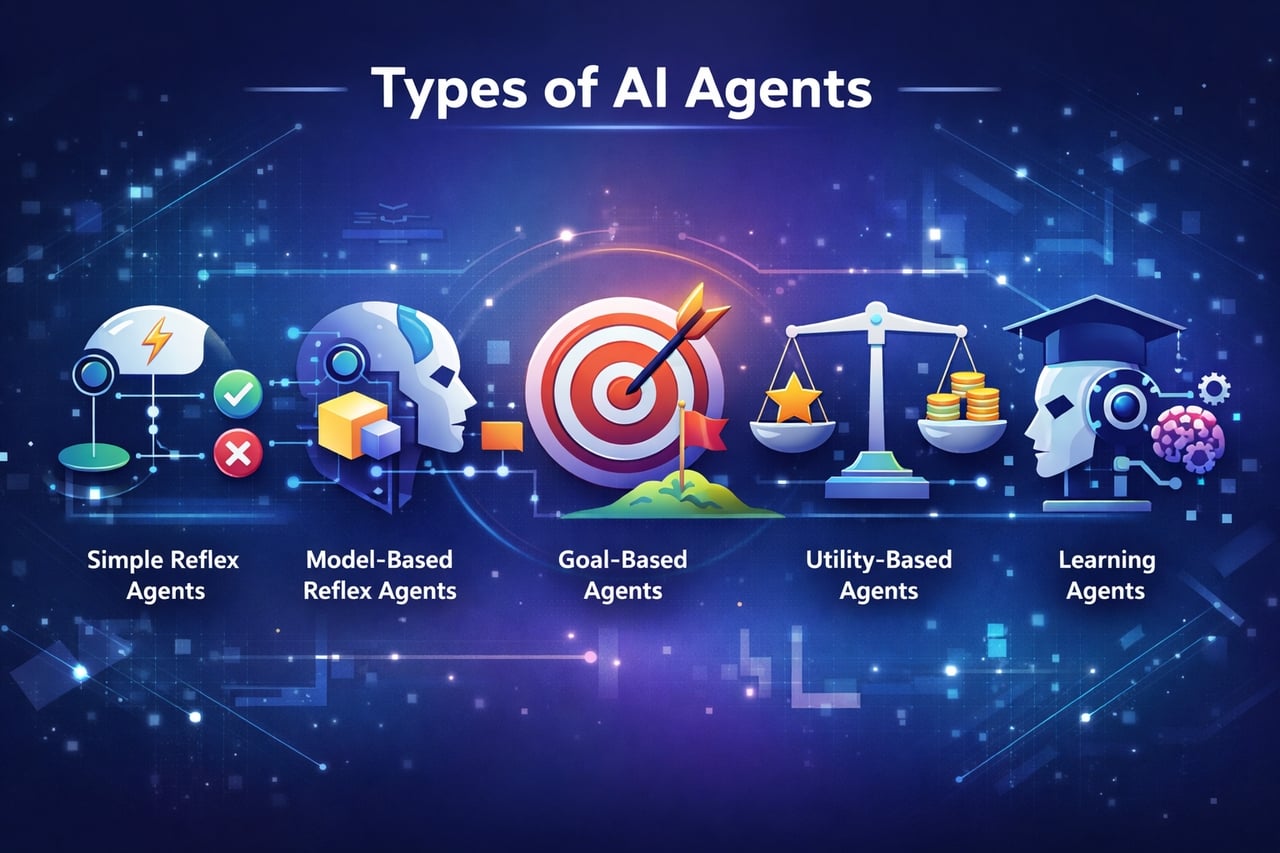
AI agents can be classified based on how they make decisions and interact with their environment. Each type uses a different strategy to process information and determine actions. Understanding these core types helps explain how agentic systems operate across various real-world applications.
- Simple reflex agents
Simple reflex agents respond directly to current inputs using predefined rules. They do not store memory or consider past states when making decisions. Instead, they follow condition–action rules such as “if this happens, perform that action.” These agents work well in simple environments where decisions depend only on immediate input.
- Model-based reflex agents
Model-based reflex agents maintain an internal representation of the environment. This internal model helps the agent track how the world changes over time. By combining current input with stored information about previous states, these agents can make more accurate decisions in environments where conditions change frequently.
- Goal-based agents
Goal-based agents make decisions by evaluating whether actions help achieve a specific objective. They analyze possible outcomes and choose the actions that bring them closer to their goal. This type of agent is commonly used in systems that require planning, such as navigation software or automated logistics systems.
- Utility-based agents
Utility-based agents go a step further by evaluating multiple possible outcomes and selecting the one that maximizes overall value or efficiency. They assign a “utility score” to different options and choose the action with the highest expected benefit. These agents are often used in complex decision-making environments.
- Learning agents
Learning agents improve their performance over time by analyzing feedback and experience. They adapt their behavior based on past results, allowing them to handle new situations more effectively. This ability makes learning agents ideal for applications such as recommendation systems, adaptive automation, and intelligent assistants.
Top 8 examples of AI agents
These AI agents examples show how agentic systems automate tasks, analyze data, and improve decision-making across industries and digital workflows.
- Customer support AI agents
Customer support systems are among the most common AI agent examples used by businesses today. These agents automatically respond to customer queries, troubleshoot issues, and route tickets to the correct department. They can check order status, provide product information, process refunds, and escalate complex problems to human representatives. By working 24/7, they help companies reduce response times, improve customer satisfaction, and handle large volumes of support requests efficiently.
- Personal productivity agents
Personal productivity assistants are powerful examples of AI agents designed to simplify daily work. These agents manage calendars, schedule meetings, draft emails, summarize documents, and organize task lists. By analyzing user preferences and past interactions, they can suggest priorities and automate routine communication. Many professionals use productivity agents to streamline workflows, reduce administrative tasks, and focus on more strategic work.
- Autonomous research agents
These are prime examples of agentic AI designed to handle information overload. Unlike a standard search engine, these agents can browse the live web, verify data across multiple reputable sources, and synthesize their findings into a structured report. They are widely used by market analysts and academics to generate deep insights and competitive intelligence reports on autopilot.
- Sales and lead generation agents
Sales automation tools are popular examples of agentic AI used in marketing and revenue teams. These agents identify potential customers, analyze lead data, send personalized outreach emails, and update CRM systems automatically. They can also track engagement, recommend follow-up strategies, and prioritize leads based on conversion likelihood. This helps sales teams increase efficiency while improving the quality of customer interactions.
- Finance and trading AI agents
Financial systems provide another strong example of ai agent applications. These agents monitor market conditions, analyze trading patterns, and execute investment strategies automatically. By processing large volumes of financial data in real time, they can detect opportunities or risks faster than manual analysis. Banks, hedge funds, and fintech platforms often use these systems to support algorithmic trading and financial forecasting.
- AI coding agents
Software development tools are increasingly becoming intelligent assistants that support programmers throughout the development process. These agents can generate code, detect bugs, suggest improvements, and even assist with deployment. Developers use them to speed up development cycles, improve code quality, and automate repetitive programming tasks. Platforms like Enter Pro enable developers to build applications faster by planning features, generating clean code, and creating interfaces through simple chat prompts.
- Supply chain optimization agents
Supply chain systems are another example of AI agents used by large organizations. These agents analyze demand trends, inventory levels, and shipping data to optimize logistics operations. They help businesses forecast demand, plan deliveries, and reduce supply chain delays. By continuously analyzing operational data, supply chain agents can recommend adjustments that improve efficiency and reduce operational costs
- Healthcare AI agents
Healthcare systems increasingly rely on intelligent technologies to support medical professionals. These agents analyze patient data, monitor health conditions, and assist doctors with diagnostic insights. They can process medical records, detect patterns in health data, and alert clinicians about potential risks. Healthcare organizations use these systems to improve patient monitoring, support clinical decision-making, and enhance medical research.
Emerging AI agent: Enter Pro
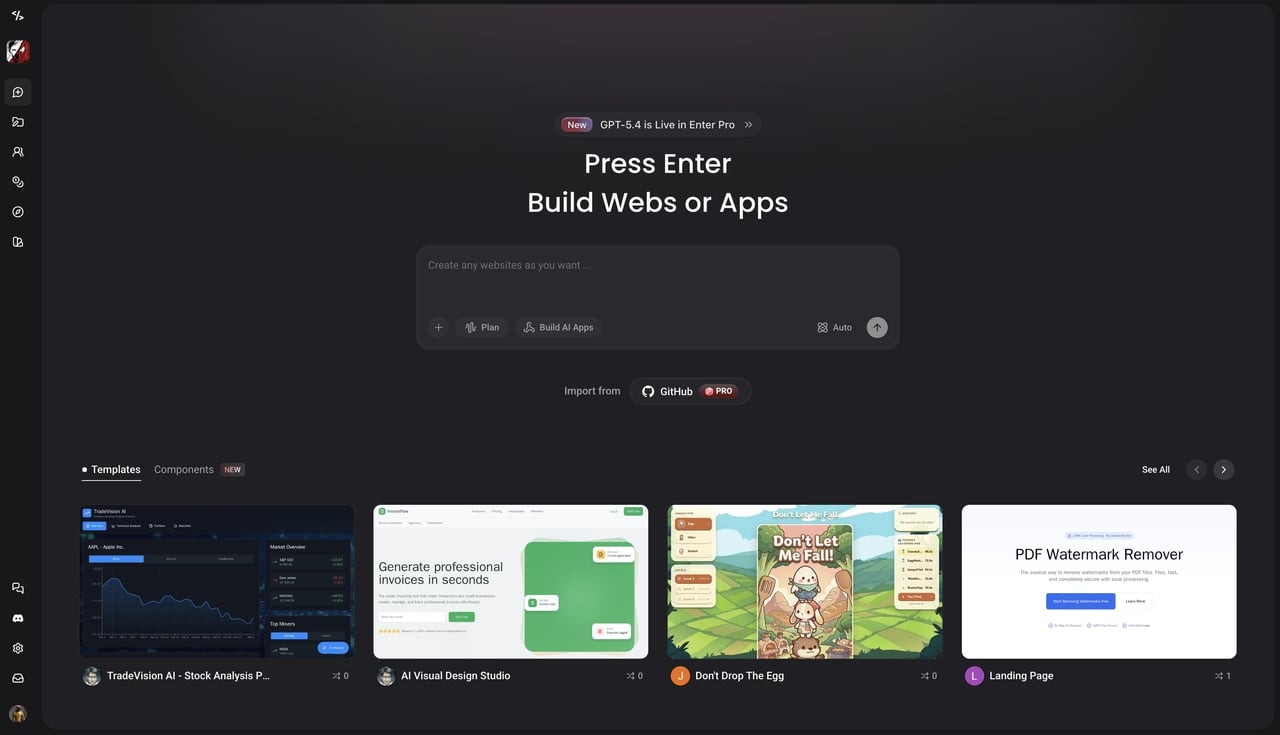
Enter Pro is the premier platform for the Vibe Coding Era, enabling anyone to build full-stack applications, websites, e-commerce websites, portfolios, and AI tools through natural language. By moving beyond simple chat, Enter Pro provides an autonomous workspace where specialized agents collaborate to turn your ideas into high-quality, production-ready code, hosting, and live deployments instantly.
-
Plan Agent: The architect of your project. It performs multi-step agentic reasoning to break down complex requests into a logical roadmap. It defines the database schema, chooses the right integrations, and verifies the logic before a single line of code is written.
-
Code Agent: The technical powerhouse. This agent writes clean, efficient, and modular code for all your features and tools. Whether it's setting up a Supabase backend or a Stripe payment flow, the Code Agent ensures every integration is robust and follows best practices.
-
Design Agent: The creative lead. It instantly generates beautiful, responsive user interfaces and visual assets. It ensures your app doesn't just work—it looks professional across all devices, utilizing modern frameworks like Tailwind CSS to create polished, accessible designs.
-
**AI Dev Agent: **The main orchestrator of the entire platform. Positioned as "Your AI Dev Agent for the Vibe Coding Era," it manages the other agents, handles the overall app or website building process, and translates your chat prompts into a fully functioning digital product.
Why Enter Pro excels for AI agents in 2026
- Conversational creation
Enter Pro allows users to build intelligent agents using simple natural language instructions. You can describe what you want, such as building a customer support agent that checks order status and escalates issues through Slack. The platform automatically handles planning, code generation, interface creation, and workflow logic without complex configuration.
- Zero-config AI power
Enter Pro provides instant access to leading LLMs without the headache of managing individual API keys. Switch between Claude, Gemini 3 Pro, and Grok with one click. This unified interface lets you choose the best reasoning or creativity for your agent without managing any compute.
- Full-stack & integrations ready
Agents built with Enter Pro can connect to databases, payment systems, analytics tools, and communication platforms directly from prompts. Integrations with services like Supabase, Stripe, Google analytics, email, and Slack make it possible to create fully functional applications with memory, tool usage, and automated feedback loops.
- Deployment & ownership
Enter Pro removes the friction between development and production. One-click publishing deploys your agent to a global edge network with auto-scaling. You maintain 100% ownership of the clean React and Tailwind code, allowing you to export your project at any time with zero platform lock-in.
- Collaborative & mobile-friendly
Enter Pro supports team collaboration through shared workspaces where developers can review, build, and refine projects together. The platform is fully mobile-optimized, allowing you to preview performance, respond to feedback, or make quick logic tweaks on the go from your phone.
Benefits of AI agents for businesses
AI agents are helping organizations automate complex processes, improve decision-making, and increase operational efficiency. By handling repetitive tasks and analyzing large amounts of data, these systems allow teams to focus on strategic work while maintaining consistent performance.
- Increased productivity and automation
AI agents automate repetitive and time-consuming tasks such as data entry, customer responses, scheduling, and reporting. This allows employees to focus on higher-value activities like strategy and innovation. By streamlining workflows and reducing manual effort, businesses can significantly improve productivity across departments.
- Faster decision-making
AI agents can analyze large datasets in real time and generate insights quickly. They help businesses identify trends, detect anomalies, and recommend actions based on data. This enables managers and teams to make faster and more informed decisions in areas such as marketing, operations, and finance.
- Reduced operational costs
By automating routine processes, AI agents reduce the need for manual labor and minimize human errors. Companies can operate more efficiently while lowering administrative and operational expenses. Over time, this leads to cost savings and improved resource allocation across the organization.
- Continuous operation and scalability
Unlike human teams, AI agents can operate 24/7 without breaks. They can handle thousands of tasks simultaneously, making them highly scalable for growing businesses. This ensures consistent service delivery and allows organizations to manage increasing workloads without proportional increases in staff.
Challenges and considerations of using AI agents
While agentic AI offers immense potential, successful implementation requires navigating technical and ethical hurdles to ensure safe, reliable systems.
- Data privacy and security
AI agents often process sensitive data such as customer information, financial records, or internal documents. Businesses must ensure strong encryption, access controls, and compliance with data protection regulations to prevent data leaks, unauthorized access, or misuse.
- Model reliability and hallucinations
AI models can sometimes generate incorrect or misleading information. These hallucinations may affect decisions if outputs are not validated. Companies should implement monitoring systems, human review processes, and guardrails to maintain reliability and accuracy.
- Governance and ethical AI usage
Organizations need clear policies for how AI agents operate and make decisions. Ethical considerations include transparency, fairness, and accountability. Proper governance frameworks help ensure AI systems are used responsibly and comply with legal requirements.
- Integration with existing systems
Deploying AI agents often requires connecting them with existing infrastructure such as databases, CRM systems, and internal tools. Integration can be complex and may require technical planning to ensure compatibility, data flow, and system stability.
Wrapping Up
AI agents are reshaping how organizations automate workflows, analyze information, and make faster decisions. These AI agent examples demonstrate how businesses can streamline operations, improve productivity, and scale efficiently across industries. As agentic systems continue evolving, platforms like Enter Pro lead this shift with a "Vibe Coding" environment where Plan, Code, Design, and Dev Agents collaborate to turn simple prompts into production-ready apps. With zero-config access to top LLMs and full code ownership, Enter Pro simplifies building intelligent automation.
FAQs
- What are some real-world AI agents examples in 2026?
Real-world agentic AI examples include customer support assistants, autonomous research agents, coding assistants, and supply chain optimization systems. These agents automate tasks, analyze data, and make decisions.
- What are generative AI agents examples?
Generative AI agents create content while completing tasks. Examples include coding assistants that write software, marketing agents generating campaigns, research agents producing reports, and design agents building UI layouts. Enter Pro allows users to create these agents that generate code, text, and workflows automatically.
- What is an example of agentic AI in customer service?
A customer service agent that checks order status, suggests troubleshooting steps, creates support tickets, and escalates issues to human agents is a strong example of agentic AI. Businesses can build similar automated support systems using platforms like Enter Pro to manage workflows and responses.
- How can I start building my own AI agents today?
Start by visiting Enter Pro. Simply describe your agent’s goal in natural language.Enter Pro’s orchestrator handles the planning, coding, and deployment to a global edge network, giving you 100% ownership of clean React code with zero configuration or API keys required.