AI in Software Development: Understand AI in 5 Mins
Discover how AI software development is transforming modern businesses with automation, faster coding, and smarter solutions. Learn tools, benefits, and use cases.
AI software development is reshaping how modern businesses design, build, and ship software. By automating repetitive tasks, accelerating code generation, and improving overall quality, AI enables teams to deliver faster and smarter than ever before. Whether you are an experienced developer or a non-technical founder, AI and software development tools like Enter Pro make it possible to turn ideas into fully functional applications faster and with less effort. This guide covers how AI is used across the development lifecycle, its key benefits, the challenges to be aware of, and who can use it.
What is AI in software development?
AI in software development refers to the use of artificial intelligence technologies to enhance and automate various stages of the development lifecycle. It involves applying machine learning, natural language processing, and generative AI tools to assist with tasks like code generation, testing, debugging, and project management. Instead of relying solely on manual effort, developers can leverage AI to analyze data, predict issues, and optimize performance. This not only improves productivity but also ensures higher code quality and faster delivery. Ultimately, AI transforms traditional development into a smarter, more efficient, and highly adaptive process.
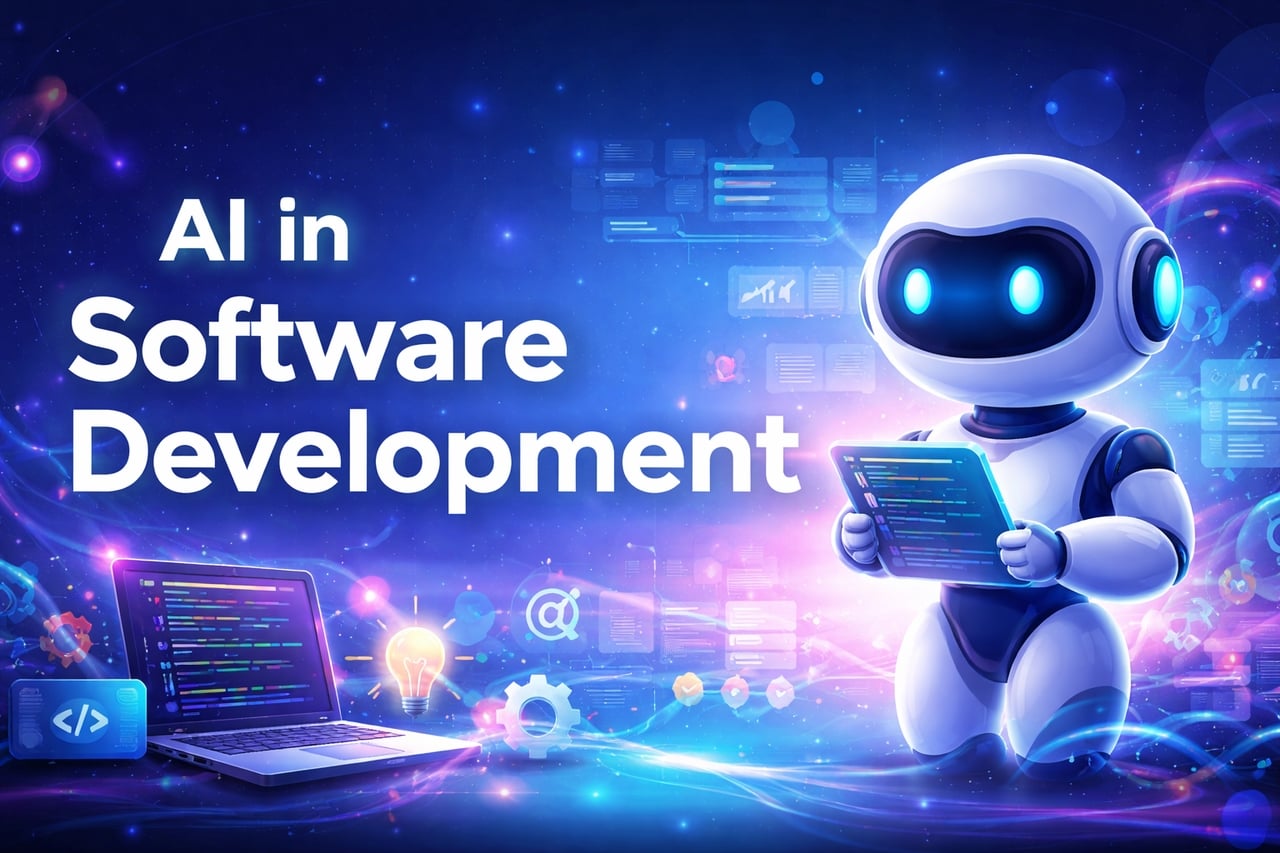
How to use** **AI in software development
AI is transforming software development by enhancing efficiency, accuracy, and innovation at every stage. From planning and design to deployment and maintenance, AI-powered tools help teams automate tasks, improve user experience, and deliver high-quality software faster.
-
Requirement analysis & planning: AI analyzes user data, market trends, and past projects to provide insights that help teams make smarter planning decisions. It identifies potential risks and resource gaps early, ensuring project scopes are realistic and data-driven.
-
Code generation & completion: With generative AI for software development, developers can generate code using simple natural-language prompts. This speeds up development and lowers the barrier for non-technical users.
-
Bug detection & fixing: AI continuously scans codebases to identify bugs, logic errors, and security vulnerabilities in real time. It flags issues early in the development cycle, reducing the cost and effort of fixing problems after deployment.
-
Testing automation: AI generates comprehensive test cases and simulates diverse user behaviors. It automatically adapts tests when the UI changes, ensuring robust quality assurance without the constant need for manual script updates.
-
Documentation and knowledge sharing: AI tools automatically generate README files, API docs, and comments from source code. This keeps knowledge current, reduces onboarding time, and ensures documentation doesn't fall behind active development.
-
CI/CD pipeline optimization: AI monitors deployment workflows to predict failures and optimize build sequences. By analyzing log data, it detects anomalies in real-time, ensuring smoother releases and faster recovery times in the delivery pipeline.
-
UX design: AI analyzes heatmaps and user journeys to suggest layout improvements. It enables rapid prototyping by converting wireframes into functional code, ensuring the final interface is intuitively aligned with actual user preferences.
Benefits of using AI software development solutions
AI is revolutionizing software development by automating tasks, enhancing productivity, and improving decision-making. Businesses leveraging AI gain faster development cycles, higher-quality code, and innovative solutions that keep them competitive in the modern digital landscape.
-
Increased productivity: AI automates repetitive tasks such as coding, testing, and documentation, freeing developers to focus on complex problem-solving and strategic work, thereby boosting overall team output.
-
Faster time-to-market: By streamlining coding, testing, and deployment, AI accelerates development cycles, allowing businesses to launch software products quickly and stay ahead of competitors.
-
Improved code quality: AI analyzes code in real time, detects errors, and suggests optimizations, ensuring higher-quality software and reducing bugs in production.
-
Cost efficiency: Automation reduces manual effort and resource needs, lowering development costs while maintaining or improving software performance and reliability.
-
Enhanced decision-making: AI provides data-driven insights throughout the development lifecycle, helping teams make informed choices on architecture, design, and functionality.
-
Better user experience: AI-driven analysis of user behavior allows developers to create more intuitive interfaces, personalized features, and responsive applications that meet user needs effectively.
Who can use AI in software development?
AI is no longer a tool reserved exclusively for data scientists or high-level engineers. Because AI and software development have become deeply integrated, various roles across an organization can now leverage these technologies to improve their workflows and outputs.
-
Professional developers: Full-stack and specialized engineers use AI for software development to automate repetitive coding tasks, refactor legacy code, and debug complex architectures. It acts as a highly skilled "co-pilot," allowing them to focus on high-level system design.
-
Non-technical founders & business owners: Through generative AI for software development, entrepreneurs can turn ideas into functional prototypes without needing deep coding knowledge. This democratizes the creation process, allowing founders to build "Minimum Viable Products" (MVPs) faster and at a lower cost.
-
Quality Assurance (QA) engineers: Testing teams use AI software development solutions to automatically generate test scripts and predict where software is most likely to fail. This shifts the focus from manual clicking to strategic risk management.
-
Product managers & analysts: These roles use AI to analyze user feedback and market data to define product requirements. AI helps them bridge the gap between business needs and technical execution by creating clear, data-backed roadmaps.
-
Enterprises and small businesses: Modern businesses use AI and software development to scale their operations. Whether it's a startup building its first app or an enterprise modernizing a massive internal database, AI provides the efficiency needed to compete in a fast-paced digital economy.
Enter Pro: Your all-in-one AI development agent
Building software has traditionally required technical expertise, long development cycles, and significant resources. Enter Pro changes that equation entirely. It is an AI-powered platform that lets individuals, startups, and businesses go from a creative idea to a fully functional app—simply by having a conversation. Rather than writing code from scratch or managing complex development workflows, users describe what they want to build in plain language, and Enter Pro handles the rest.
Powered by the latest Enter Pro AI models, including a unified integration of GPT-5.4, Claude 4.6, and Gemini 3.1 Pro, the platform autonomously orchestrates complex logic and infrastructure. This makes it one of the most accessible and practical AI software development solutions available today.
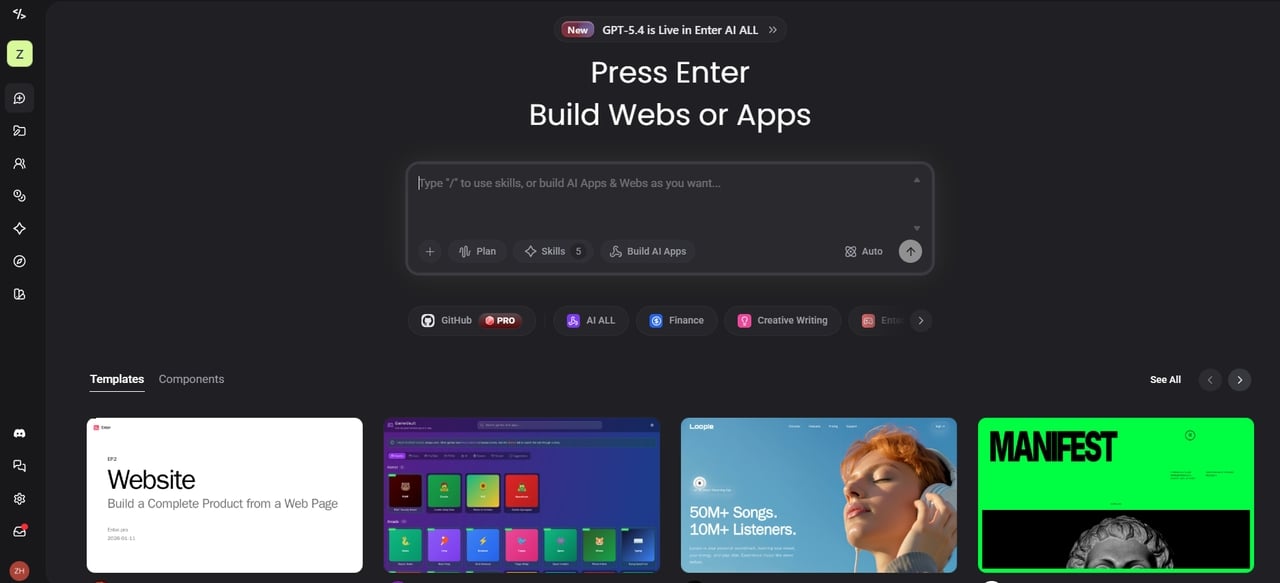
Core features for modern development
-
**Native AI at the core: **Enter Pro provides a unified API to access every leading Large Language Model, including GPT-5.4, Claude, Gemini, and Grok. You can build custom AI agents specialized in design, coding, or project planning to automate your specific business workflows.
-
**Full-stack capabilities: **Beyond simple code generation, the platform integrates backend essentials like databases, cloud storage, serverless functions, and cron jobs. It also supports seamless integrations with industry standards like Supabase, Stripe, GitHub, and Google Analytics.
-
Visual editor with real-time preview: Speed up the design process by editing layouts, fonts, and colors directly on a live preview. You can use natural language prompts to ask the AI to modify specific UI elements, making rapid prototyping more accessible than ever.
-
**Team workspace & collaboration: **Built for scale, Enter Pro features a collaborative environment where product managers, designers, and developers can work together. With role-based access control and AI-assisted code reviews, teams can maintain high standards while accelerating their deployment cycles.
-
Zero lock-in & instant deployment: You own 100% of the code you build. Enter Pro generates clean, standard React and Tailwind code that you can export at any time. When you're ready to go live, a single click deploys your project to a global edge network with support for custom domains.
Challenges of AI in software development
While AI brings immense benefits to software development, it also comes with challenges that businesses must address for successful implementation.
-
Data privacy and security: AI models trained on public repositories may inadvertently suggest insecure code or leak sensitive data. Ensuring that software development respects proprietary intellectual property and complies with global privacy regulations remains a top priority for enterprises.
-
Code Accuracy and Hallucinations: Even advanced models can produce "hallucinations"—plausible-sounding but logically flawed code. Developers must rigorously verify machine-generated output to prevent subtle bugs that could compromise system stability.
-
Integration with legacy systems: Many businesses rely on older, complex architectures that automated tools may struggle to understand. Bridging the gap between modern workflows and rigid legacy codebases requires significant manual oversight and strategic planning.
-
Ethical bias and transparency: Models can inherit biases from their training data, leading to unfair or discriminatory software behavior. Maintaining transparency in how algorithms make decisions is crucial, especially in regulated industries such as fintech and healthcare.
-
The skills gap and dependency: As teams rely more on automated solutions, there is a risk of diminishing core manual coding skills. Striking a balance between leveraging automation and maintaining deep technical expertise is vital for long-term innovation.
Conclusion
AI software development is no longer a futuristic concept—it is the modern standard for businesses seeking agility and excellence. From automating repetitive coding tasks to optimizing complex CI/CD pipelines, integrating AI into the development lifecycle ensures faster delivery and superior code quality. However, navigating this transition requires the right partner. Enter Pro stands at the forefront of this revolution, offering a seamless "vibe coding" experience that combines advanced generative AI for software development with robust, full-stack infrastructure.
FAQs
- Can AI replace software developers?
No, AI cannot fully replace developers. It acts as a powerful assistant that automates repetitive tasks and improves productivity, but human expertise is still required for decision-making, architecture design, and ensuring code quality.
- Can non-coders build apps using AI?
Yes. Platforms like Enter Pro enable individuals without technical backgrounds to build functional applications through "vibe coding." By describing features in plain English, the AI handles the underlying code, database setup, and deployment.
- Is AI software development suitable for beginners?
Yes, many AI tools are designed for beginners. No-code and low-code platforms allow users to create apps without deep programming knowledge, making AI development accessible to non-technical users and entrepreneurs.
- What is custom AI software development?
Custom AI software development involves building tailored AI-powered applications designed for specific business needs—such as intelligent automation, domain-specific machine learning models, or AI-integrated workflows unique to an industry.
- How does generative AI help developers?
Generative AI for software development allows engineers to use natural language prompts to generate code, refactor scripts, and design architecture. Platforms like Enter Pro take this further by turning ideas into full apps, reducing boilerplate work and boosting innovation.