

The Best AI Startup Ideas You Can Start Today (2026 Guide)
Discover 7 highly profitable AI startup ideas for 2026. Learn how to leverage agentic AI and tools like Enter Pro to build your next big tech business.
What is an AI startup?
An AI startup is an innovative company that leverages artificial intelligence technologies, such as machine learning, natural language processing, or computer vision, as the core component of its product or service.
Unlike traditional tech companies that might use AI as an add-on feature, an AI startup is fundamentally built around intelligent algorithms to solve complex problems, automate processes, or generate novel insights.
These AI businesses aim to disrupt existing markets or create entirely new ones by processing vast amounts of data at unprecedented speeds. Ultimately, an AI startup bridges the gap between cutting-edge academic research and scalable, real-world business applications.

Major reasons to open an AI startup in 2026
Starting an AI company in 2026 offers unprecedented opportunities. With technology maturing rapidly, the barriers to entry have plummeted, creating the perfect landscape for innovative founders to thrive.
-
Maturing agentic AI: Autonomous AI agents have evolved from theoretical concepts to reliable workers. Startups can now build systems that not only assist but independently execute complex, multi-step tasks, drastically increasing the value proposition for potential B2B and B2C customers.
-
Lower compute costs: The cost of training and running advanced models has significantly decreased due to hardware innovations and optimized cloud infrastructure. This makes it far more affordable for bootstrapped startups to launch powerful products without massive initial capital.
-
Widespread enterprise adoption: Companies across all sectors now actively seek AI integration to remain competitive. This widespread enterprise readiness means a faster sales cycle and a massive, eager market desperate for niche AI solutions tailored to their specific workflows.
-
Abundant funding opportunities: Venture capitalists continue to pour billions into the AI ecosystem. Innovative AI startup ideas with a solid execution plan stand an incredibly high chance of securing substantial seed funding, as investors look for the next generational tech unicorn.
-
Open-source democratization: The explosion of high-quality open-source models allows founders to build without relying entirely on expensive proprietary APIs. This provides unmatched flexibility, better data privacy control, and the ability to fine-tune models specifically for your unique startup use case.
-
Availability of specialized talent: The talent pool has grown exponentially. In 2026, you will find an abundance of experienced prompt engineers, ML operations specialists, and AI ethicists ready to help you scale, making team building faster and much more efficient.
Top 7 AI startup ideas for 2026
If you are looking to enter this dynamic AI market, here are seven highly lucrative AI business startup ideas for 2026 that address critical pain points across various rapidly growing global industries.
- Hyper-personalized healthcare companions
The healthcare sector is ripe for AI disruption. An AI healthcare companion startup can monitor patient vitals via wearables, track medication adherence, and provide real-time, personalized dietary and lifestyle recommendations.
By integrating with electronic health records, these conversational agents can alert human doctors to early warning signs before a crisis occurs. This idea not only reduces the burden on overworked medical professionals but also provides patients with 24/7 accessible care. With an aging global population, proactive AI healthcare solutions offer immense scalability, profound societal impact, and a highly attractive proposition for health-tech investors.
- Autonomous supply chain negotiators
Global logistics remain complex and volatile. A startup focused on AI supply chain negotiators can revolutionize how businesses source materials. Using autonomous agentic AI, these systems can independently analyze global market trends, predict shortages, and autonomously negotiate contracts with international vendors in real-time.
By continuously optimizing for the best prices and delivery times without human intervention, businesses can save millions. This B2B startup idea provides an immediate, measurable return on investment for clients, making it an incredibly sticky product with high retention rates and significant enterprise value in the modern globalized economy.
- Generative AI for interactive education
Traditional education is often one-size-fits-all. An AI startup building adaptive, generative learning platforms can create customized curricula that adjust in real-time to a student's learning pace and style. Imagine an AI tutor that instantly generates engaging historical simulations, personalized math problems, and interactive science experiments based on a child's unique interests.
This approach ensures maximum engagement and knowledge retention. With the rise of remote learning and the constant demand for skill up-gradation among professionals, an AI-driven education platform has a massive addressable market spanning from K-12 students to adult corporate training programs.

- AI-powered legal contract analysts
Legal departments drown in paperwork. Creating an AI startup that specializes in deep legal analysis can dramatically speed up due diligence and contract review. By training models on specific regional laws and corporate compliance standards, this tool can instantly highlight risky clauses, suggest alternative terminology, and ensure regulatory compliance across multiple jurisdictions.
Unlike generic AI, a specialized legal model offers the high accuracy and strict data privacy that law firms demand. This significantly reduces billable hours spent on mundane tasks, allowing lawyers to focus on high-level strategy, making it a highly profitable niche.
- Synthetic data generation for privacy
As data privacy regulations tighten globally, companies struggle to find compliant data to train their own algorithms. A startup offering premium synthetic data generation solves this massive bottleneck. By analyzing real datasets, your AI can create mathematically identical, completely artificial datasets that contain zero personally identifiable information.
This allows enterprises in highly regulated fields like banking, insurance, and healthcare to safely train machine learning models without risking data breaches or violating GDPR laws. As the foundation of AI development relies on data, being the secure supplier of that data is a brilliant strategy.
- Automated ESG compliance trackers
Environmental, Social, and Governance (ESG) reporting is becoming mandatory for large corporations, yet tracking it is notoriously difficult. An AI startup can automate this by scraping supply chain data, monitoring carbon emissions via satellite imagery, and analyzing corporate communications to generate real-time, accurate ESG scores.
This software can help companies identify inefficiencies, avoid greenwashing penalties, and attract ethically minded investors. As governments enforce stricter climate regulations globally, a B2B SaaS platform that instantly translates complex environmental data into actionable, compliant reports will become an absolute necessity for every major enterprise on earth.
- Immersive AI video game masters
The gaming industry is crying out for truly dynamic experiences. A startup building AI "Game Masters" can generate endless, responsive storylines, non-player character (NPC) dialogues, and entirely new quests tailored to the individual player's actions in real-time. Instead of pre-programmed, static worlds, every single playthrough becomes a unique, living narrative.
By licensing this AI engine to indie developers and major AAA gaming studios, your startup can become the invisible backbone of the next generation of entertainment, dramatically cutting game development costs while exponentially increasing player retention and replay value.
How to super-charge your AI startup with Enter Pro?
Building a cutting-edge business from these best AI startup ideas requires more than just a vision; it demands a powerful, centralized platform to manage your operations, scaling, and team collaboration. This is where Enter Pro comes in.
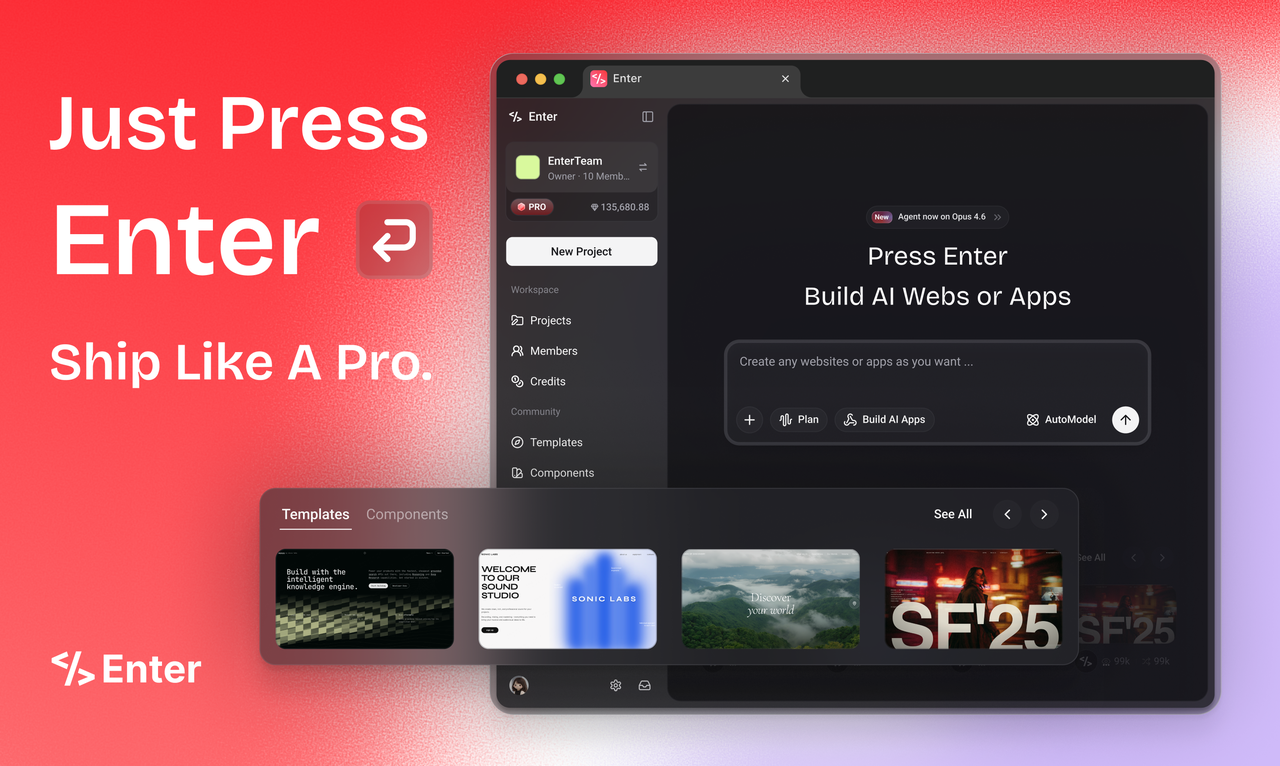
Enter Pro is a revolutionary "vibe coding" agent and no-code AI development platform designed to turn anyone into a full-stack developer. Instead of struggling with complex syntax, Enter Pro acts as your personal AI dev agent, taking your plain text prompts and instantly transforming them into deployed, professional-grade applications or websites, with full backend logic.
Enter Pro provides a single subscription to access the world's most powerful LLMs (like Claude 4.5, GPT 5.2, and Gemini Pro) without any complex API configuration.
Additionally, by offering complete 100% code ownership, a visual editor for precision tweaking, and a collaborative workspace, Enter Pro provides the ultimate ecosystem to streamline your workflow and launch your AI startup in record time.
Why use Enter Pro for your AI startup:
-
Seamless API integrations: Enter Pro allows you to effortlessly connect multiple large language models and proprietary databases into one unified dashboard, drastically reducing your startup's initial development time and coding complexity.
-
Advanced analytics engine: Track your AI product's performance in real-time. Enter Pro provides deep insights into user engagement, token usage, and latency, enabling you to optimize costs and improve user experience instantly.
-
Automated scaling infrastructure: Never worry about server crashes during viral moments. Enter Pro automatically scales your cloud computing resources up or down based on real-time traffic, ensuring absolute reliability and cost efficiency.
-
Enterprise-grade security: Protect your sensitive training data and algorithms. Enter Pro comes with built-in end-to-end encryption, SOC2 compliance, and granular role-based access control to keep your intellectual property completely safe.
-
Agile project management: Keep your engineers and marketers aligned. Enter Pro features intuitive Kanban boards, automated sprint planning, and AI-assisted bug tracking to ensure your team consistently hits crucial launch deadlines.
-
Built-in monetization tools: Start generating revenue faster. Enter Pro includes native billing systems, subscription management, and flexible usage-based pricing models, allowing you to seamlessly monetize your AI services from day one.
Tips and tricks for building an AI startup in 2026
Navigating the competitive tech landscape requires strategic foresight. To maximize your chances of success and build a sustainable business, keep these crucial tips in mind when launching your AI startup.
-
Focus on niche problems: Avoid building generic chatbots. The most successful AI startup ideas in 2026 target highly specific, underserved niches. Solve one painful problem for a distinct industry incredibly well, rather than trying to be a mediocre tool for everyone.
-
Prioritize data quality: An AI model is only as good as its training data. Invest heavily in acquiring high-quality, clean, and proprietary data. Unique datasets will be your strongest competitive moat against larger tech giants trying to enter your space.
-
Build trust and transparency: AI hallucinations remain a concern. Design your user interface to be transparent about AI's limitations. Build features that allow users to verify AI's reasoning, fostering immense trust and ensuring long-term loyalty from your customer base.
-
Design for the human loop: Complete automation isn't always the goal. The best AI tools augment human capabilities rather than replacing them entirely. Build intuitive workflows that keep human experts in the loop for final approvals, especially in high-stakes industries.
-
Monitor regulatory changes: Global AI regulations are shifting rapidly. Stay ahead of compliance laws regarding data privacy, copyright, and algorithmic bias. Building compliance into your core architecture from day one will save you from massive legal headaches down the line.
-
Iterate quickly with user feedback: Launch your minimum viable product (MVP) as fast as possible. Real-world user interactions will reveal unexpected edge cases and prompt engineering flaws. Continuous, rapid iteration based on direct customer feedback is the ultimate key to market fit.
Wrapping up
The landscape for building an AI business has never been more fertile. By leveraging advanced tools, open-source models, and an eager enterprise market, 2026 is the perfect time to explore these innovative generative AI startup ideas.
Whether you choose to disrupt healthcare, revolutionize logistics, or redefine education, success hinges on solving real, specific problems with high-quality data and transparent systems. Remember to utilize powerful platforms like Enter Pro to streamline your journey. The future belongs to those who can bridge the gap between artificial intelligence and human needs. Now is the time to start building your legacy.
FAQs
Do I need to know how to code to start an AI startup?
Not necessarily. With the rise of no-code AI builders and API integrations, non-technical founders can build strong MVPs. However, having a technical co-founder is highly recommended for long-term scaling.
How much does it cost to start an AI company?
Costs vary wildly. A bootstrapped SaaS using existing APIs might cost a few thousand dollars, while training proprietary foundational models can require millions. Start lean, prove traction, then seek funding.
How do I protect my AI ideas for startups from being stolen?
Ideas are cheap; execution is everything. Focus on building a strong data moat and moving fast. You can use NDAs, but gaining rapid market share is your best true protection.
What is the biggest risk for an AI startup in 2026?
The biggest risk is building a "wrapper" easily replicated by major AI labs. To survive, you must solve a deep workflow problem using proprietary data that generic models cannot access.
How do I find investors for my AI startup?
Start by building a functional prototype and gaining early users. Then, network at tech incubators, pitch to specialized AI venture capital firms, and leverage platforms like AngelList or Y Combinator.