
React vs Angular: Which Should You Choose in 2026?
React vs Angular in 2026: compare learning curve, performance, jobs and the latest news (Angular 22, React Foundation) to pick the right one for your project.
The React vs Angular debate has taken a new turn in 2026, as both projects underwent extensive transformations, collectively surpassing the changes of the past five years. React left Meta, and moved to an independent foundation in the Linux Foundation, where the question of control of its future was resolved.
Stable Signal Forms and zoneless change detection are now the default in Angular v22 for creating new apps. Today the Angular vs React debate is not as it was in 2024 if you are thinking about what to learn, or what to build your next product on.
This article explains what changed, which one is easier to learn, how they compare head-to-head, how real companies chose, and which is perfect for your project.
Quick Answer: Go with React if you want the largest ecosystem, the fastest way to get to a working application and React Native for mobile. If you're in a "big team" situation where you require a single structure with routing, forms, http and testing from the beginning, then go with** Angular**.
What Is Angular vs React?
What Is React?
React is a JavaScript library to create interfaces using small reusable components coded in JSX. It was transferred to the Linux Foundation's React Foundation in February 2026, and has been joined by founding members Amazon, Meta, Microsoft and Vercel. The current line is React 19.x, and React Compiler 1.0, introduced in October 2025 & stable since then, takes care of memoisation. Most teams do not use React exclusively. They look for a framework such as Next.js or React Router.
What Is Angular?
Angular is a complete Google framework and it is TypeScript-first. All the components (router, forms, the HTTP client, the dependency injection, the CLI and testing tools) are developed by the Angular team themselves. The latest version is v22, which was released in June 2026. Standalone components are now the default, signals are used to drive reactivity, and new apps now automatically take advantage of zoneless change detection.
Library vs Framework: The One Difference That Explains Everything Else
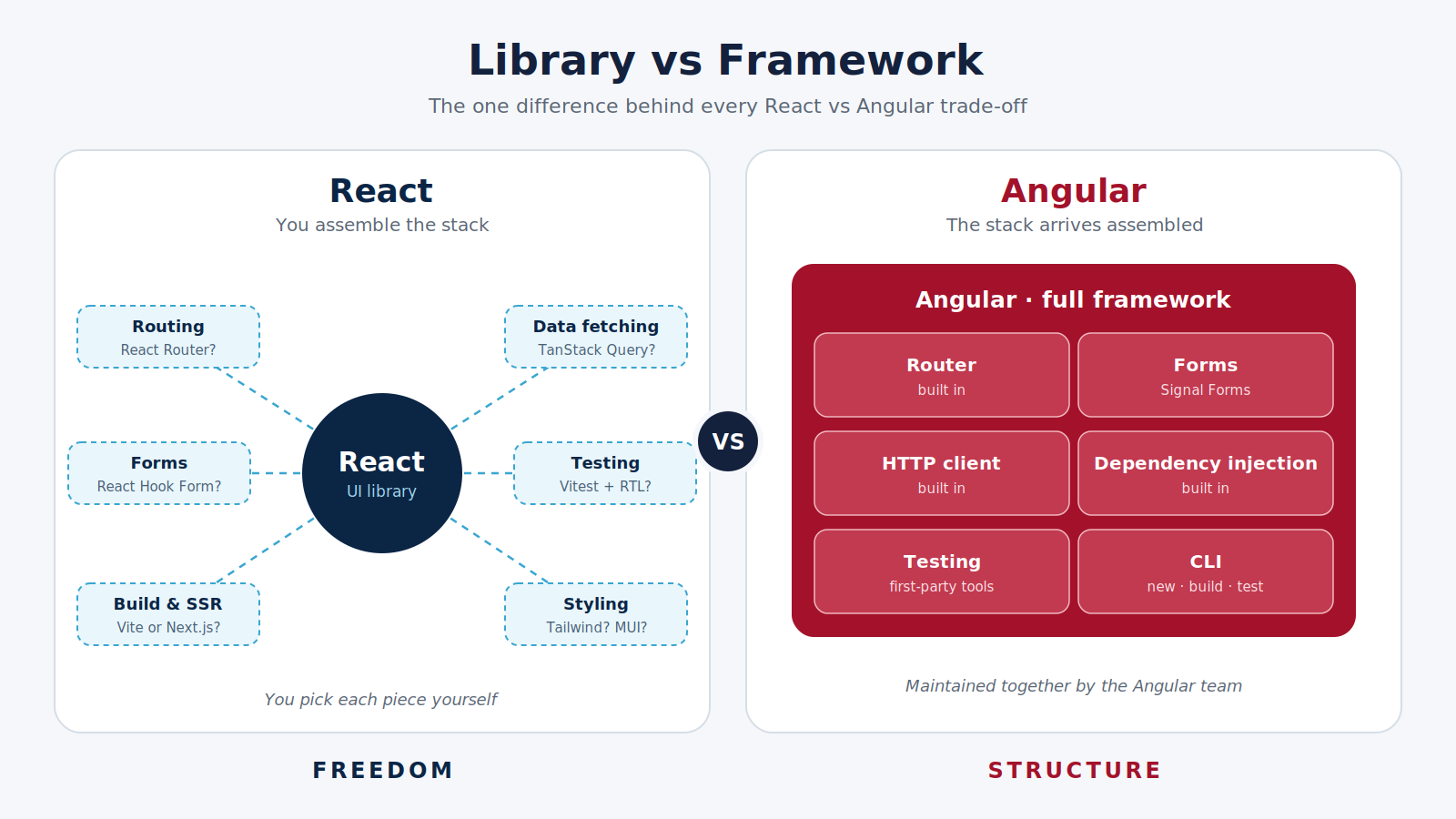
Here’s the short version: with React, you assemble the stack yourself. With Angular, the stack arrives already assembled. Almost every trade-off you’ll read about below traces back to that single choice. Freedom or structure? If you’d rather not make that call before you’ve even tested your idea, an AI MVP builder can give you a working app first.
React vs Angular 2026 at a Glance
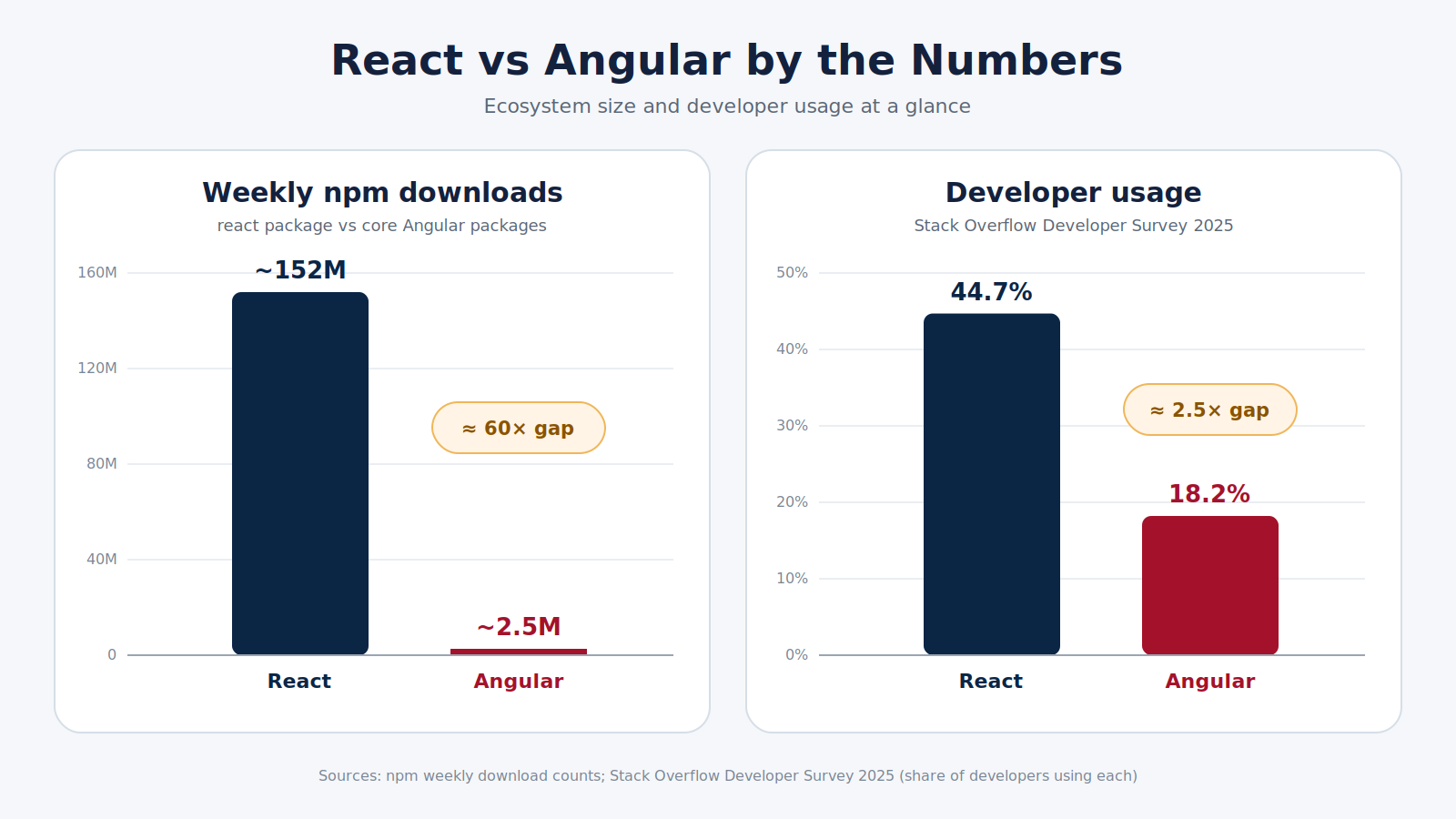
The table below shows the comparison of Angular vs. React for the year 2026. Before reading a single row, one number you shouldn't miss before scanning: React's weekly npm downloads are about 60 times more than Angular's; that's a pretty good indicator of the size of the ecosystem and the ease of hiring.
| Feature | React | Angular |
|---|---|---|
| Type | UI library | Full framework |
| Owner / steward | React Foundation (Linux Foundation) since Feb 2026 | |
| Latest version | React 19.x | Angular v22 (June 2026) |
| Language | JavaScript / JSX (TypeScript optional) | TypeScript (required) |
| Reactivity model | Virtual DOM + React Compiler (automatic memoization) | Signals + zoneless change detection |
| Built-in routing, forms, HTTP | No, choose libraries | Yes, all first-party |
| SSR option | Next.js / React Server Components | Angular SSR with hydration |
| Mobile | React Native (mature, battle-tested) | Ionic / NativeScript / Capacitor |
| Learning curve | Easier start; ecosystem decisions later | Steeper start; fewer decisions later |
| Usage (Stack Overflow 2025) | 44.7% | 18.2% |
| Weekly npm downloads | ~152M (react package) | ~2.5M (core Angular packages) |
| Best for | Startups, MVPs, design-heavy UIs and cross-platform mobile | Large teams, regulated industries and multi-year platforms |
The download gap is stark but needs context. The lower user count of Angular, indicated by the npm number, is due to the smaller and more enterprise-focused user base, not a quality issue. Angular teams are larger, longer-lived, and are less likely to change stacks in the middle of the project. React's popularity is driven by its default status for every new project, tutorial, and the fact that a lot of small-scale teams are shipping quickly.
The split between the two usage numbers, Stack Overflow (44.7% vs 18.2%), mirrors the same: React is the generalist's tool; Angular is the specialist's. These two numbers do not indicate which is 'better' for you. It depends on whether you want an ecosystem depth or consistency.
React vs Angular News: What Changed in 2026
Anyone who has last "checked" these frameworks 2 years ago is working with false assumptions. 2026 was a year of two significant governance and release changes in both projects. Let's look at what really changed and how it affects your decision.
React Leaves Meta as the React Foundation Launches (Feb 24, 2026)
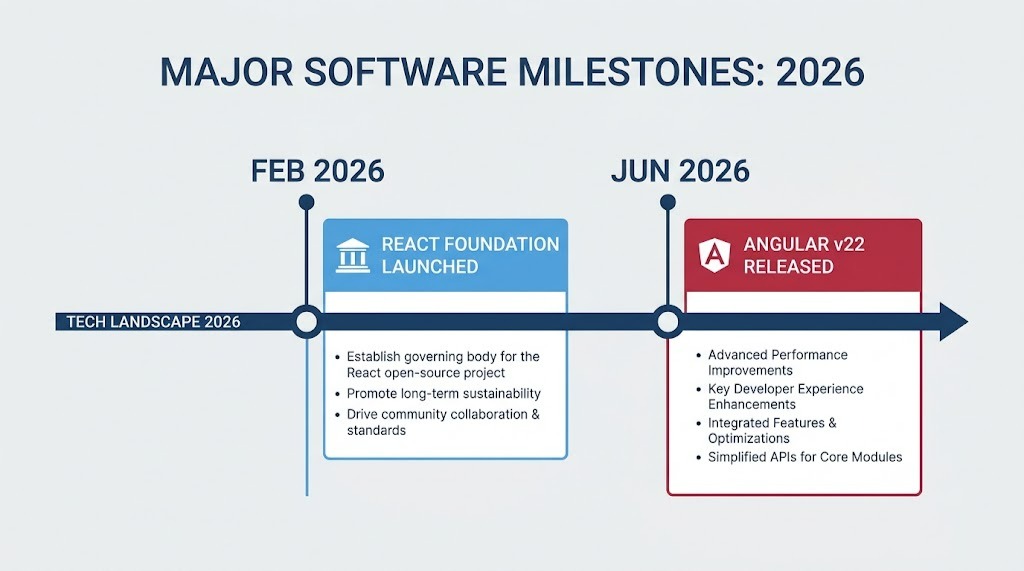
On February 24, 2026, React, React Native and JSX formally moved out of Meta and into the React Foundation under the Linux Foundation. The React Foundation now governs the project with eight Platinum members, and technical direction remains with the maintainers. While Meta is still a founding Platinum member alongside Amazon, Microsoft and Vercel, and continues to fund it for the multi-year period, technical direction is now in the hands of the maintainers instead of a company's roadmap.
Takeaway: reduced risk of single vendor. Any team that ever had a problem with wagering on a Meta project is now settled. This is the most significant change for teams considering React vs Angular news. React isn't a Meta-controlled project anymore; it's a foundation-backed project.
React Compiler 1.0 and the 19.x Line
React Compiler 1.0 stabilized in October 2025 and it's one of the best features for beginners. With automatic memoization at build time, you won't need to become an expert with useMemo and** useCallback** before deploying production code. The compiler takes care of this.
It auto memoizes components and hooks at build time, and Meta reported that their initial loads and navigations improved by up to 12%, while some interactions were over 2.5× faster. This translates to less hooks for the learners to learn for optimization before shipping production code.
Angular v22 (June 3, 2026): The Signals-First Release
Angular v22 added stability to Signal Forms and Angular Aria, OnPush became the default change detection strategy and added @Service() and injectAsync decorators. It also added Angular MCP tooling and agent skills (angular-developer, angular-new-app) for AI coding assistants. Fetch-based http is now the default, TypeScript 6 has become a requirement and Angular now ships mcp and agent tooling for AI coding assistants.
What the 2026 News Means for Your Decision
There's a stronger bet on both frameworks than there was in 2024. The "verbose and outdated" reputation of Angular is somewhat defunct given the default use of signals and standalone components. And now, the question of who owns React is finally answered.
Choosing between React and Angular in 2026 is not just about risk mitigation; it's about aligning with your team's structure and goal.
React vs Angular: Which Is Easier to Learn?
In short: React is easier to get going and Angular is easier to stick with. Let's look at how that works in practice.
What You Need to Know Before Your First React App
JavaScript + JSX, components, props, state and hooks. The basic API is actually very small, and you can create something real over the course of a weekend. The hard part isn't React itself; it's choosing the ecosystem. Which router? Which data-fetching library? Which form solution? React provides you with freedom, yet freedom involves decisions, and decisions slow beginners down.
What You Need to Know Before Your First Angular App
Angular requires more up front: TypeScript, templates, control flow (@if, @for), signals, dependency injection and the CLI. More concepts come upfront, but fewer decisions remain later. Signals have reduced the old "RxJS everywhere" burden that made Angular notoriously difficult for beginners.
Same Feature, Two Frameworks (Code Comparison)
Here is a task list with a done counter, built both ways (imports left out).
React 19
export default function Tasks() {

  const [tasks, setTasks] = useState([{ text: "Learn React", done: false }]);

  const toggle = i => setTasks(tasks.map((t, j) => j === i ? { ...t, done: !t.done } : t));

  return (<>

    <p>Done: {tasks.filter(t => t.done).length}</p>

    <ul>{tasks.map((t, i) => <li key={i} onClick={() => toggle(i)}>{t.text}</li>)}</ul>

  </>);

}
Angular 22
@Component({

  selector: 'app-tasks',

  template: `<p>Done: {{ doneCount() }}</p>     <ul>@for (t of tasks(); track $index) {       <li (click)="toggle($index)">{{ t.text }}</li>     }</ul>`,

})

export class Tasks {

  tasks = signal([{ text: 'Learn Angular', done: false }]);

  doneCount = computed(() => this.tasks().filter(t => t.done).length);

  toggle(i: number) {

    this.tasks.update(l => l.map((t, j) => j === i ? { ...t, done: !t.done } : t));

  }

}
A Realistic 30-Day Learning Roadmap for Each
| Week | React Path | Angular Path |
|---|---|---|
| 1 | JavaScript/JSX, components, props | TypeScript, components, templates |
| 2 | State, hooks, events | Signals, control flow, services |
| 3 | Routing (React Router), data fetching | Angular Router, HTTP client, forms |
| 4 | Small project (task app + API) | Small project (task app + API) |
Verdict: React helps you build your first functioning app quicker. Angular is able to get a team to a consistent codebase faster. In terms of which is easier to learn, React is easier to learn if you're a one-person team, and Angular is easier to learn if you're a developer in a structured enterprise team.
Myth vs Fact
- Myth: “Angular requires NgModules.” Fact: Standalone components are the default in v22.
- Myth: “Meta owns React.” Fact: The React Foundation has owned it since February 2026.
- Myth: “Start with Create React App.” Fact: It’s deprecated. Use Vite or a framework.
- Myth: “Angular is dying.” Fact: v22 shipped on schedule with production-ready features, and Google relies on Angular internally.
React vs Angular: Head-to-Head Comparison
After the learning curve, the true distinctions emerge as to how each framework responds to pressure. Let's take a look at how they compare on the features that are most important.
Performance and Rendering
React uses a virtual DOM optimized with automatic memoization provided by React Compiler. By default, Angular uses fine-grained signals with OnPush and zoneless change detection. In practice, actual performance is more dependent on architecture than the framework. If a React app isn't well structured, it will lose to a well-structured Angular app and vice versa.
Scalability and Team Size
Angular's enforced structure helps to minimize decision fatigue and onboarding variance with teams of 10+ developers. The flexibility of React allows small teams to be agile and fast on their feet, but can cause architectural decisions to seep in as headcount grows in the team.
Ecosystem and Tooling
React has a much bigger ecosystem: there are more UI libraries, tutorials, and third-party integrations. Angular's CLI and first-party tooling offer a more cohesive development experience, with less unexpected compatibility issues. React is usually used with Vite or Next.js, and Angular ships with its own CLI.
SEO and Server-Side Rendering
Both can be good for SEO. React is built with Next.js and React Server Components; Angular has native SSR and hydration. Both are weaker from an SEO perspective if they're purely client-side apps.
Mobile Development
React Native is the well-developed cross-platform mobile option. Angular depends on Ionic, NativeScript or Capacitor. If mobile is a first-class requirement, then React has the clearer path.
Testing
Angular's integrated DI and testing frameworks ensure uniform unit testing practices throughout the team. React is dependent on React Testing Library and Vitest, which are great but need to be disciplined by the team to standardize.
Jobs, Salaries and Hiring
React is the bigger talent pool and has more postings in general. Angular jobs are smaller in volume but more specialized, concentrated in enterprise, finance, and government, often at senior levels and usually command higher rates.
Real-World Case Studies: Who Picked What and Why

Each story shows the situation, the call and the lesson. If your own need is internal software, an internal tool builder can shortcut the choice.
Babbel: Moving from AngularJS to React with Zero Downtime
Babbel's internal Content Authoring Tool was designed and developed using AngularJS, 80+ directives and 1,400 unit tests. The team opted to take the approach of wrapping the React components within AngularJS using react2angular, migrated the tests incrementally and tolerate the temporarily fat bloated while both frameworks ran side by side.
Lesson learned: Incremental migration can work, but plan for dual framework load.
Canonical (MAAS): Evaluating Angular vs React for a Legacy UI
Canonical also tested both Angular and React and decided on using React for the MAAS UI. They split the UI into its own repository, kept the legacy AngularJS app running alongside, and standardized build and testing infrastructure across products.
Lesson learned: Don't choose a team agility or repo structure based on hype.
Songkick: Lessons from a Year-Long Incremental Migration
Instead of opting for a big-bang rewrite, Songkick opted to migrate side-by-side, moving from AngularJS to React piece by piece, selling tickets continuously. The biggest mistake was not explaining the "why" to non-engineering teams.
Lesson learned: Migrations are not just technical, they are also organizational.
Google and YouTube: Why Google Doubled Down on Angular
YouTube's UI is now built with Angular Signals and Angular run highly interactive Google products such as Google Cloud Console and Google Analytics.
**Lesson learned:**Angular's roadmap is driven not only by community excitement, but also by Google's own production requirements.
Counterpoint: A Small Team That Chose Angular over React
A data-heavy internal app with a small team chose Angular because routing, HTTP, and forms were already decided for them. Lesson: "Small project = React" is not a rule. Structure can be an asset at any size.
Best React vs Angular Choice for Your Project
Still undecided? Match your situation to the lists below, then check the scorecard for a quick answer.
Choose React If
- You’re building an MVP or startup product and need to ship fast. You can ship a working MVP in days.
- Your product is a consumer-facing, design-heavy UI.
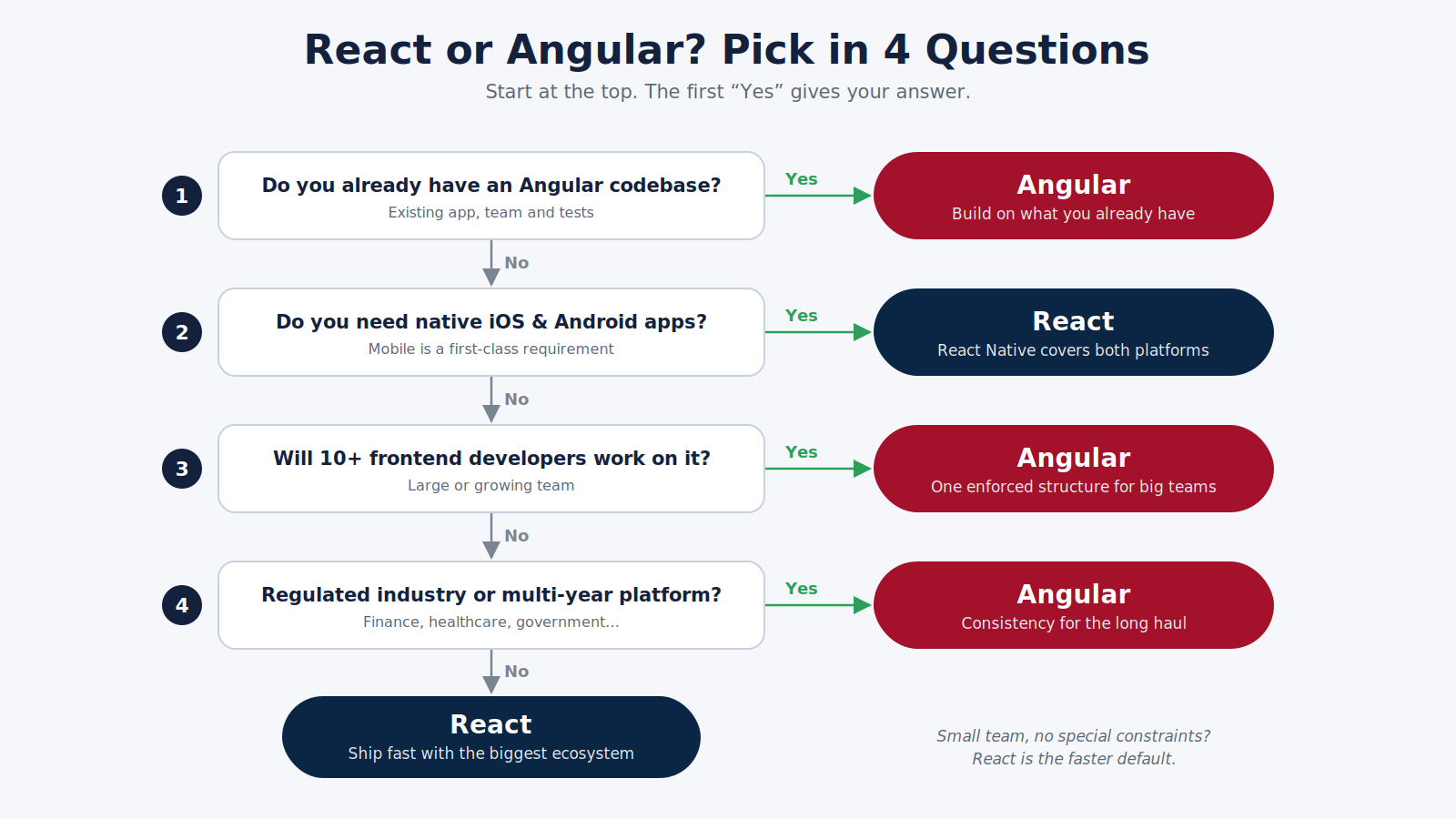
- You want React Native for iOS and Android.
- You need an SEO-heavy site built with Next.js.
- Hiring speed and talent pool size matter most.
Choose Angular If
- You have 10+ frontend developers.
- You work in a regulated industry (finance, healthcare, government).
- You are building a multi-year platform.
- Your team is TypeScript-first.
- You already have an Angular codebase.
Decision Scorecard
| Scenario | Best pick | Why |
|---|---|---|
| SaaS dashboard | React | Rich UI libraries and a big talent pool |
| E-commerce storefront | React (Next.js) | Mature server rendering and SEO tooling |
| Internal admin tool | Either | build internal admin tools without code |
| Enterprise portal | Angular | One enforced structure for large teams |
| Content / SEO site | React (Next.js) | Server rendering built for search |
| Cross-platform app | React | React Native covers iOS and Android |
| Legacy AngularJS modernisation | Incremental, usually React | Migrate side by side, as Babbel did |
Let's visualise the decision-making process for you
Not Writing Code Yourself? Build It with AI First
For founders and product managers: AI app builders now generate working React front ends from a prompt, so you can validate the idea before hiring for either stack. Describe your product and get a live React app with a database, hosting, and a custom domain. Then hand the code to developers when you are ready to scale.
Conclusion: React vs Angular in 2026
Neither framework is universally better. React wins on flexibility, ecosystem breadth, and learning speed for beginners. Angular wins on structure, large-team consistency, and first-party tooling for regulated industries. The 2026 news (React Foundation governance and Angular v22's signals-first release) made both safer bets than they were two years ago. Use the scorecard above, match it to your team size and project lifespan, and you will make the right call.
Turn your idea into a working React app today. Not sure which framework your product needs yet? Describe it to Enter Pro and get a live React + Vite + Tailwind app with database, hosting, and a custom domain built in. Iterate in the visual editor, own the code, and hand it to your developers when you are ready to scale.
FAQs About React vs Angular
FAQ1. Is React or Angular better in 2026?
Neither is universally better. React suits startups, MVPs, and flexible teams; Angular suits large enterprise teams needing enforced structure.
FAQ2. React vs Angular which is easy to learn?
React is easier for a first app because the core API is smaller. Angular is easier to learn one consistent pattern that scales across a large team.
FAQ3. Is Angular dying in 2026?
No. Angular v22 shipped in June 2026 with stable Signal Forms and AI tooling, and Google relies on Angular internally for products like YouTube and Google Cloud Console.
FAQ4. Does Meta still own React?
No. Since February 24, 2026, React is owned by the React Foundation under the Linux Foundation, with Meta as one of eight Platinum members.
FAQ5. Which has more jobs, React or Angular?
React has more postings overall. Angular jobs cluster in enterprise, finance, and government, often at senior levels.
FAQ6. Which has more jobs, React or Angular?
It depends on specific regions, but on an average React has significantly more jobs than Angular. With the advent of AI app builders like Enter Pro, the learning curve is much smaller for anyone trying to master both.
FAQ7. Can I switch from Angular to React (or the reverse) later?
Absolutely! You can switch between both Angular and React at any time of your career. It's a very common practice among front end developers. With platform like Enter Pro, you can keep using both to develop apps while you learn the new craft.