MVP Product Development: Meaning, Features, and Approach
What is MVP in software development? Learn MVP product development, cost breakdown, and best practices for startups and businesses.
MVP development helps startups and businesses launch their products to market as quickly as possible. With Enter Pro, it is possible to streamline the process of MVP app development using automation tools, task management, and data insights. The process helps businesses reduce the overall cost of development while increasing the efficiency of MVP app development. It is one way of achieving business success in the least time possible.
What is MVP in software development?
A Minimum Viable Product (MVP) is a version of a product with only the core features necessary to validate an idea with early users. MVP development is crucial for startups and businesses, as it enables a faster time-to-market, reduces costs, and minimizes risk before a full-scale launch. Unlike a prototype, which tests concepts, or a full product, which includes all planned features, an MVP focuses on essential functionality for real-world validation. Successful MVPs like Airbnb, Dropbox, and Spotify demonstrate how MVP development can guide product evolution and ensure market fit efficiently.

Why MVP development is essential for startups and businesses
MVP development helps startups and businesses validate ideas quickly, reduce costs, and deliver products efficiently.
-
Faster time-to-market: By focusing on core features, MVP development allows teams to launch products quickly. This rapid delivery helps businesses capture opportunities early, stay ahead of competitors, and test market demand without investing heavily in a full-scale product.
-
Early user validation: MVP development provides a platform for real users to interact with your product. Gathering feedback early enables teams to identify strengths, fix issues, and make informed decisions to align the product with market needs.
-
Cost-efficient development: Focusing only on essential features reduces development expenses. MVP development ensures resources are used wisely, minimizing waste and maximizing return on investment while still producing a functional product for testing.
-
Risk reduction: By testing the core concept first, MVP development lowers the risk of launching a product that doesn't meet market needs. Early validation helps avoid costly mistakes and guides feature prioritization for full-scale releases.
-
Focus on core features: MVP development emphasizes delivering the product's most critical functions. Concentrating on what truly matters improves usability, avoids feature bloat, and ensures a clear value proposition for users from the start.
MVP software development for Startups vs Enterprises: Key Differences
MVP software development helps businesses validate ideas quickly, but startups prioritize speed and early feedback, while enterprises focus on scalability and long-term integration.
| Aspect | Startups | Enterprises |
|---|---|---|
| Goal | Validate product-market fit quickly | Test new product ideas with high user volume |
| Budget | Limited, cost-conscious | Larger, more resources available |
| Team Structure | Small, cross-functional team | Multiple specialized teams with project managers |
| Tech Stack | Lightweight, fast to implement | Enterprise-grade, scalable, and secure |
| Time to Launch | Fast (weeks–months) | Moderate (months) with compliance and integration checks |
| User Base | Early adopters, small audience | Large audience, multiple departments |
| Feedback Loop | Rapid iteration | Structured iteration with analytics and KPIs |
MVP development process step by step
Adopting these strategies helps streamline MVP software development into a more structured and efficient workflow:
-
Idea validation and market research: First off, identify your target audience and understand the problems they face. Validate the idea to ensure the problem and solution align. Conduct a competitive analysis to identify market gaps and opportunities that your MVP will capitalize on during product development.
-
Feature prioritization and planning: Carefully select the features your application will have. Ensure the features chosen address the main problems your application will solve. Plan your MVP to ensure the development process remains swift and easy. Proper planning will ensure the process remains efficient and cost-effective.
-
Design and prototyping: Create a design and a prototype to visualize the structure and features of your MVP. Test the application to identify possible flaws and correct them. This will ensure the application meets user expectations and requirements before the actual development process starts.
-
MVP app development with agile methodology: Develop your MVP using agile methodology, which offers flexibility in the development process. This will allow your application to adapt to the ever-changing expectations and requirements of users.
-
Testing, launch, and user feedback: This involves conducting extensive usability testing, debugging, and improving MVP performance. Launching the product to real users and gathering actionable feedback is important to ensure that the MVP is validated before scaling up or building the product.
-
Optimize and scale with Enter Pro: Use Enter Pro to optimize and scale the development process. This will help you obtain actionable insights to improve the product's functionality and efficiency, thereby preparing the MVP for scaling and success.
Modern solution: Ship your MVP in minutes with Enter Pro
The traditional barrier between a great idea and a functional product has finally been dismantled. Enter Pro is the world's first AI-native development platform designed to turn natural language prompts into production-ready software in record time. Whether you are a solo founder launching an MVP, a product manager building live demos without a single line of code, or a creator shipping fully monetized games, Enter Pro provides the engine to build at the speed of thought.
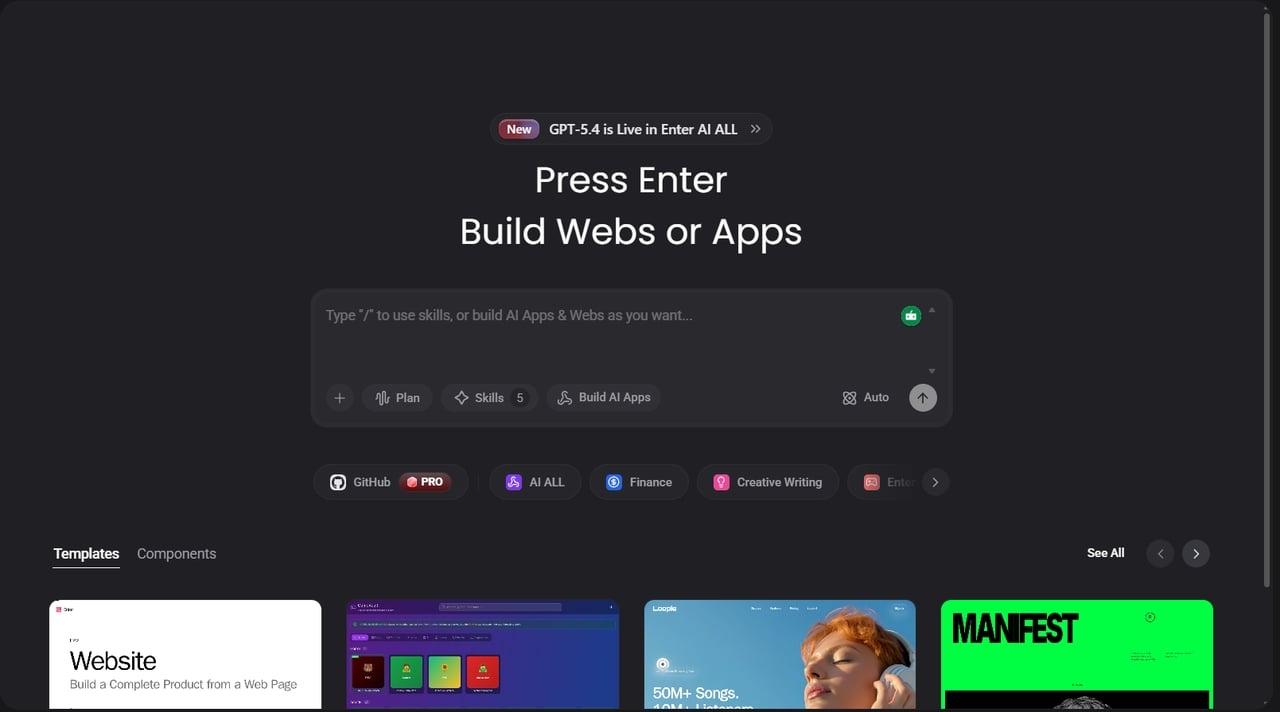
How to ship MVP with Enter Pro:
Enter Pro simplifies the entire MVP development process, helping startups and development teams plan, execute, and refine projects efficiently.
Step 1: Define your vision and core features
Start with a clear definition of your MVP idea and prioritize the key MVP feature set that addresses the main user problem. Use Enter Pro to document the requirements, set the goals, and determine the most appropriate approach for the development of your MVP app development.
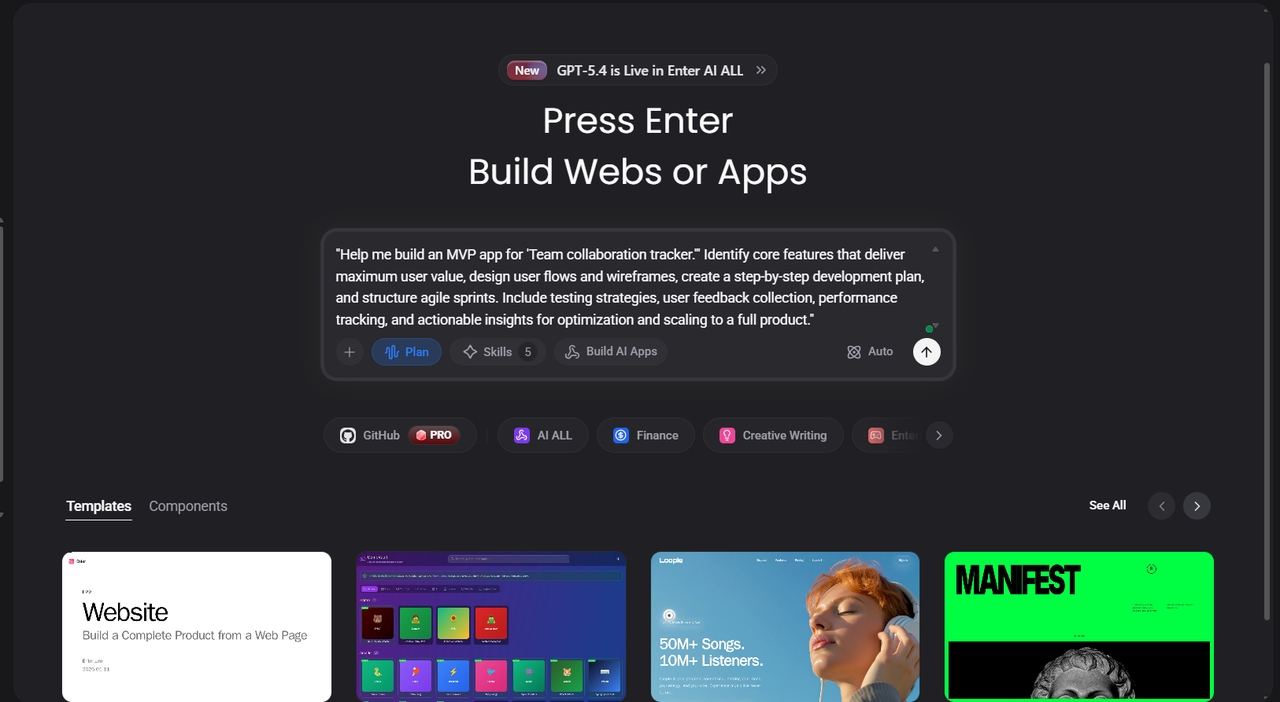
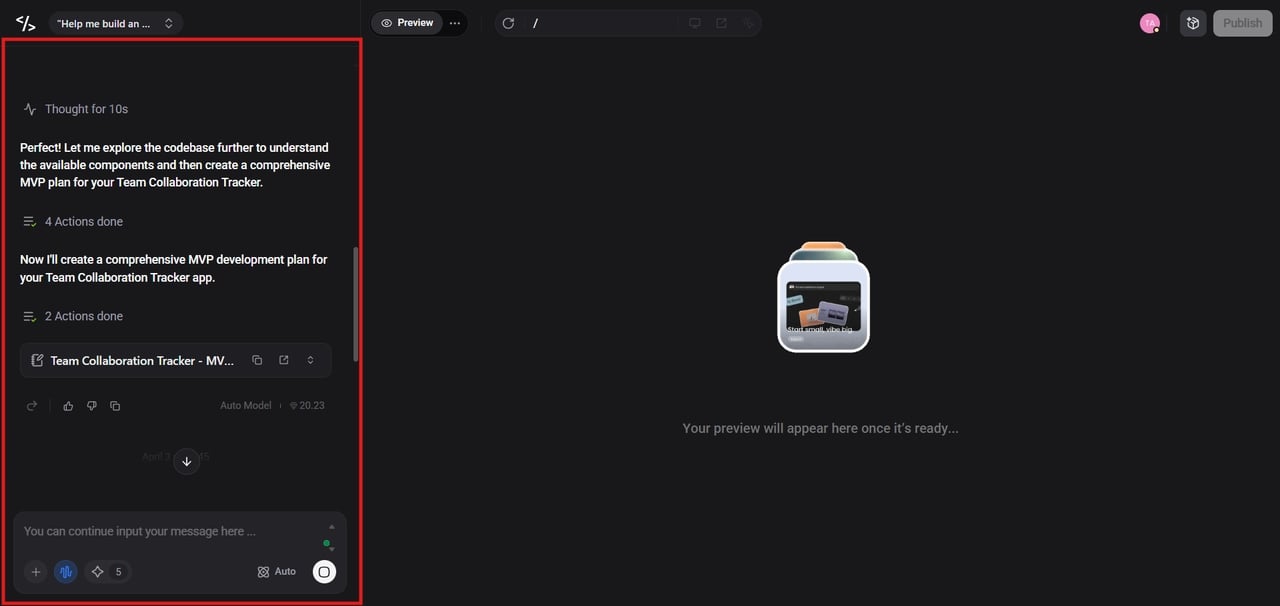
Step 2: Let Enter Pro plan and build your MVP
Enter Pro helps structure the MVP app workflow through task assignment, development planning, and feature optimization. This helps teams streamline coding, interface, and feature integration, allowing for faster MVP app development with reduced errors.
Step 3: Test, refine, and scale
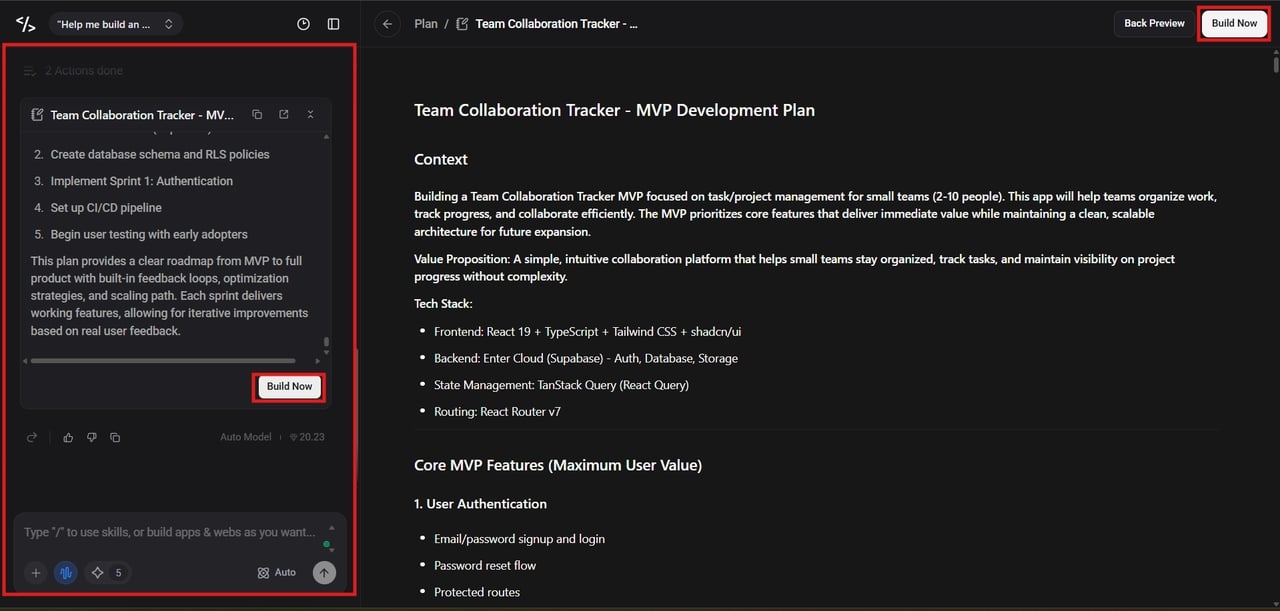
Enter Pro can be utilized to keep an eye on performance, collect user feedback, and continually improve the MVP. Data-driven insights can be used to improve functionality, user experience, and scaling the product, clicking on Build Now to ensure the MVP is ready for launch.
Key features of successful MVP product development
-
Core Functionality: The key to a successful MVP lies in delivering the core functionality required to solve the main problem. Prioritizing key functionalities in MVP development helps speed up product completion and validate the product idea.
-
**User-Focused Design: MVP development should be user-centric. User experience **plays an important role in MVP development. The user experience helps deliver the product in a way that maximizes it.
-
Scalability: The MVP must be scalable, even though it is minimal. The architecture in MVP development must be designed so that the product can be easily extended and new functionality can be added.
-
Performance: The product's performance must be high during MVP development. The product's performance ensures the user experience. The product's performance must be optimized during MVP development.
-
Efficiency: In MVP development, efficiency ensures the maximum utilization of resources. The resources must be utilized to obtain the maximum output in the minimum possible time.
MVP development cost breakdown
-
Cost factors: Allocate funds strategically for development, testing, user feedback, and scaling. Effective MVP development budget planning ensures resources are used efficiently and prepares the team for future iterations or full product launch.
-
Team and tech stack impact: The team involved in development and the tech stack used can affect the overall MVP development cost. It is worth noting that the more experienced the team is, the more it might cost; however, the end product will be delivered in the least time possible.
-
Timeline vs cost: In MVP development, a shorter timeline may require additional resources, increasing costs, while longer timelines can reduce pressure but delay market entry. Balancing speed and budget is key to achieving cost-effective delivery.
-
Cost optimization tips: Focus on essential features, reuse existing components, and leverage automation to reduce expenses. Proper planning and iterative development in MVP development help minimize unnecessary spending while maintaining product quality.
-
Budget planning: The MVP development budget-planning process is important to the overall MVP development process. The more the MVP development budget planning process is taken into account, the more the MVP development process will be optimized.
MVP app development and agile approach
-
Agile methodology: Using agile methodology in MVP app development allows teams to work in flexible, iterative sprints. This approach ensures that core features are delivered efficiently while adapting to changing requirements and user needs during the development process.
-
Continuous feedback: In MVP development, continuous feedback from users and stakeholders is critical. Collecting and analyzing insights early enables teams to refine features, fix issues quickly, and make informed decisions that align the product with market expectations.
-
Iterative improvement: Iterative improvement is at the heart of agile MVP development. By developing, testing, and refining the product in cycles, teams can enhance functionality, usability, and performance while reducing risks and optimizing resources.
-
Combining MVP and agile benefits: Integrating MVP app development with agile practices accelerates time-to-market, improves product quality, and ensures better alignment with user needs. This combination reduces costs, minimizes risks, and supports rapid validation of core features before full-scale launch.
Comparison of MVP Development vs Prototype vs Full Product
Compare MVP development, prototypes, and full products to choose the right approach for validating ideas, testing features, and launching market-ready solutions.
| Feature/Aspect | MVP Development | Prototype | Full Product |
|---|---|---|---|
| Purpose | Validate ideas quickly, test core features | Explore concept, design, and usability | Complete solution for market launch |
| Scope | Minimal, functional features only | Limited or non-functional, visual design focused | Full features and functionalities |
| Time to Market | 2–6 months (fast) | Few days/weeks (conceptual) | 6–18 months (longer) |
| Cost | Low to medium, cost-effective | Very low | High, requires full resources |
| User Feedback | Early and actionable | Limited, mostly internal or test users | Continuous, after launch |
| Agile Integration | Fully compatible, iterative | Can be agile if expanded | Agile or waterfall, depending on scale |
| Risk Level | Low–medium | Very low | High if unvalidated |
Best practices for MVP software development in real-world projects
Following best practices in MVP app development ensures faster delivery, better user validation, and scalable software solutions.
-
Simplicity: Focus on the product's core functionality and solve the main user problem. Avoid unnecessary features that can complicate development or confuse users. Simplicity ensures faster development, easier testing, and a clear demonstration of value, making it easier to validate your idea on the market.
-
User value: Prioritize features that directly address the needs and pain points of your target audience. MVP development should provide tangible value from the start, enabling meaningful feedback and guiding the design of future enhancements to improve user satisfaction.
-
Fast iteration: Adopt an iterative approach to build, test, and refine your MVP quickly. Fast iteration allows teams to respond to user feedback in real-time, fix issues promptly, and continuously improve functionality while keeping development timelines short.
-
Scalability: Even as a minimal product, design the MVP with scalability in mind. Ensure the architecture supports future feature additions, increased user traffic, and integration with other systems, preparing the product for long-term growth and market expansion.
-
Agile approach: Use agile methodologies to manage development in flexible sprints. Continuous collaboration, regular feedback loops, and adaptive planning ensure that the MVP evolves effectively, aligns with user expectations, and minimizes development risks.
Conclusion
MVP software development enables startups and organizations to build products quickly, validate ideas early, and optimize them based on user feedback. With the help of Enter Pro, organizations can develop their MVP apps efficiently. These are effective methods for improving scalability and efficiency in developing software applications.
FAQ'S
- How to improve MVP in software development using user feedback?
Improving the MVP in software development can be achieved through real-time user feedback. By understanding the problems users face in the application and the features they require, the MVP can be improved most efficiently.
- What is agile development in MVP projects?
Agile development in MVP projects is an iterative methodology where teams build, test, and refine core features in short cycles. This approach allows continuous feedback integration, rapid validation of ideas, and flexible adaptation to changing requirements, improving product quality and time-to-market.
- How can Enter Pro improve MVP app development?
Enter Pro enhances MVP app development by streamlining workflows, automating repetitive tasks, and providing data-driven insights. It helps teams plan, build, test, and scale MVPs efficiently, ensuring faster delivery, higher quality, and better alignment with user needs.
- How to assemble a successful MVP development team?
A successful MVP development team combines developers, designers, and product managers with complementary skills. Team members should be agile, collaborative, and focused on efficiently building core features while collecting feedback, enabling rapid iteration, and maintaining alignment with business goals.
- What is the difference between MVP and minimum marketable product (MMP)?
An MVP (Minimum Viable Product) focuses on core features to validate an idea with minimal investment. An MMP (Minimum Marketable Product) includes enough features to attract early paying customers. While MVP prioritizes learning and feedback, MMP prioritizes delivering immediate market value and revenue.