

What Must an Entrepreneur Do After Creating a Business Plan?
Learn what an entrepreneur must do after creating a business plan—from funding and legal setup to execution, marketing, and scaling your startup successfully.
Drafting a comprehensive business plan is a massive milestone, but for many founders, the moment the last page is finished is when the real anxiety sets in. You have the strategy on paper, yet the path to actual revenue often feels like a disorganized maze. What must an entrepreneur do after creating a business plan? Many struggle with the "paralysis of analysis," where the sheer volume of tasks—from legal hurdles and fundraising to building a digital presence—leads to costly delays and missed market opportunities.
Without clear direction, many face common pitfalls like poor execution, lack of market validation, and running out of cash — reasons why a large percentage of startups fail despite having a solid plan.
In this guide, you'll discover the essential steps to take after creating a business plan—from validating your idea and setting up your business legally to launching, marketing, and scaling successfully.
Why a business plan is important for Entrepreneurs
Before diving into execution, it's essential to understand why a business plan matters in the first place. A well-crafted business plan is more than just a document—it acts as a roadmap that guides your decisions, reduces risks, and helps you stay focused on your goals. It lays the foundation for everything that follows in your entrepreneurial journey.
-
It keeps you organized: A business plan turns scattered ideas into a structured roadmap. It defines your goals, identifies potential challenges, and creates the processes you'll need before you launch — not after problems arise.
-
Helps you secure funding: Investors and lenders want to see evidence that you've thought things through. A comprehensive business plan gives them confidence in your vision and dramatically improves your chances of getting a yes.
-
Validates your idea: Writing a plan forces you to research your market, study your competition, and pressure-test your assumptions. If something doesn't hold up on paper, it won't hold up in the market either.
-
Helps you measure performance: Your business plan sets the benchmarks — revenue targets, milestones, financial projections. Without it, you have no baseline to measure progress against or course-correct when things go off track.
-
Provides clarity of vision: A strong business plan aligns your team, guides your decisions, and ensures that everyone from your first hire to your first investor understands the mission, the market, and the path to profitability.
What must an entrepreneur do after creating a business plan? Steps
Once the strategy is finalized, the transition from planning to action begins. This is where you move from theory to tangible progress. To ensure your startup gains immediate momentum, follow these essential steps:
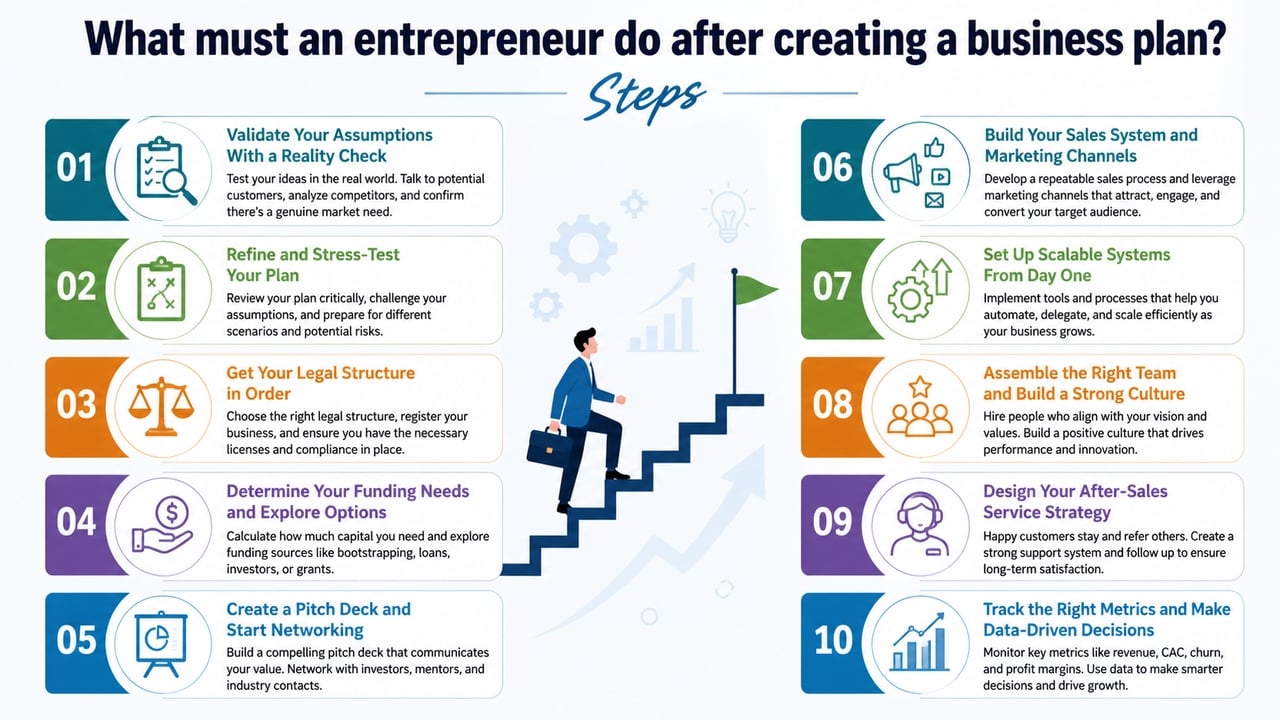
Step 1: Validate your assumptions with a reality check
A business plan is built on assumptions: your market, your customers, your costs, and your competition. Before investing significant time or money, you need to stress-test those assumptions against real-world conditions.
Instead of a full-scale launch, start small. Run a pilot project, release a minimum viable product (MVP), or host a pop-up event to gauge genuine demand. Talk directly to your target customers — ask whether they would pay for your product, what features matter most, and what alternatives they currently use.
Crowdfunding platforms like Kickstarter are also powerful validation tools. A successful campaign doesn't just raise money; it proves demand before you commit to full production.
Step 2: Refine and stress-test your plan
Completing your business plan doesn't mean it's finished. Once you've gathered real feedback, go back and refine it. Review every section critically, look for weak assumptions, and get input from other entrepreneurs or business professionals who can spot what you've missed.
Pay close attention to your financial projections, competitive analysis, and go-to-market strategy. These are the sections investors and lenders scrutinize most, and where overoptimistic thinking most commonly hides.

Step 3: Get your legal structure in order
This step is one of the most skipped and most costly steps to fix later. Around 20% of small businesses fail within the first year, often due to inadequate legal foundations.
Lock down your legal structure early:
-
Choose your business entity: LLC, corporation, sole proprietorship, or partnership. Each carries different implications for taxes, liability, and investor readiness.
-
Draft a partnership agreement if you have co-founders, defining equity splits, roles, decision-making authority, and exit terms.
-
Protect your intellectual property: Register trademarks, file patents where applicable, and use NDAs when sharing sensitive information with potential partners or investors.
-
Set up vendor and customer contracts with clear terms around deliverables, payments, and dispute resolution.
Getting this right at the start is far cheaper than fixing it after a dispute arises.
Step 4: Determine your funding needs and explore options
Now it's time to figure out exactly how much capital you need to execute your plan — covering everything from equipment and inventory to salaries and marketing. Having a clear number makes it easier to target the right funding source.
Your main options include:
-
Angel investors and venture capitalists provide capital in exchange for equity, along with networks and mentorship.
-
Business loans you retain full ownership, benefit from predictable repayment schedules, and can build your business credit score in the process.
-
Bootstrapping: Self-funding keeps equity intact and forces financial discipline early.
-
Crowdfunding: Raises capital while simultaneously validating market demand.
Choose based on your growth timeline, how much control you want to retain, and what kind of support beyond money your business actually needs.
Step 5: Create a pitch deck and start networking
If you're seeking outside investment, your business plan needs a companion — a concise, compelling pitch deck. It should cover your problem, solution, market size, business model, traction, team, and funding ask in 10 to 15 focused slides.
Beyond the deck, never underestimate the power of networking. Attend industry events, connect with fellow entrepreneurs, and make sure the right people know what you're building. Every conversation is a potential door to funding, to partnerships, to your next key hire.

Step 6: Build your sales system and marketing channels
A business plan without a revenue engine is just a document. You need a clearly defined sales pipeline and marketing strategy before you open your doors.
Map out your sales stages, such as lead generation, qualification, proposal, and closing. Then choose marketing channels that match both your audience and your budget:
-
Content marketing builds long-term organic trust and compounding traffic.
-
Performance ads via Google or Meta deliver faster results but require careful ROI tracking.
-
Social media works best when matched to your business type — LinkedIn for B2B, Instagram and TikTok for consumer brands.
Start with two or three channels, execute them well, and expand once you have traction.
Step 7: Set up scalable systems from day one
Around 70% of businesses fail because they scale too quickly without the right systems in place. Building with scale in mind from day one doesn't mean complex infrastructure; it means intentional planning.
-
Automate repetitive tasks like invoicing, onboarding emails, and social scheduling.
-
Use cloud-based tools for project management, CRM, and accounting that grow with your team.
-
Document every key process, so workflows don't live only in your head.
-
Build flexible financial models that account for multiple growth scenarios.
Systems aren't bureaucracy. They're what allow you to delegate confidently as your business grows.
Step 8: Assemble the right team and build a strong culture
Once you have direction and funding, focus on the people who will help you execute. Hire for cultural fit alongside skills — skills can be taught, but values and attitude are much harder to change.
Define your core values early and let them shape every hiring decision. Lead by example — your behavior as a founder sets the cultural tone for the entire organization. Research consistently shows that businesses with highly engaged teams significantly outperform those with disengaged teams, in both productivity and profitability.

Step 9: Design your after-sales service strategy
Most entrepreneurs invest heavily in acquiring customers and underinvest in keeping them. Research shows that a 5% increase in customer retention can boost profits anywhere from 25% to 95% — making retention one of the highest-ROI areas you can focus on.
Build your retention infrastructure early:
-
Onboarding support to help customers get value from your product quickly.
-
A self-service knowledge base so customers can find answers without contacting support.
-
A clear feedback loop: Post-sale surveys and reviews show customers you care about and give you data to improve.
-
A loyalty or referral program to reward repeat customers and turn buyers into advocates.
Step 10: Track the right metrics and make data-driven decisions
Data-driven decision-making separates businesses that adapt from those that guess their way into decline. Identify the metrics that reflect the true health of your business and track them consistently from the start.
The core metrics to monitor:
-
Customer Acquisition Cost (CAC) vs. Lifetime Value (LTV): When CAC exceeds LTV, you're losing money at scale.
-
Churn rate: High churn signals a gap in product value or customer experience.
-
Conversion rate: At every stage of your funnel, from visitor to lead to paying customer.
-
Revenue growth: Month-over-month trends reveal momentum or early warning signs.
Use tools like Google Analytics, HubSpot, or Mixpanel to track in real time. Run A/B tests regularly and let the results guide your next move — not instinct alone.
How Enter Pro helps entrepreneurs after a business plan
Turning a business plan into a real product can be overwhelming, especially when it involves development, design, and execution. Platforms like Enter Pro simplify this process by enabling entrepreneurs to build, launch, and scale digital products using AI—without needing advanced technical skills. It helps founders move faster from idea to execution by automating development, streamlining workflows, and reducing operational complexity, making it ideal for startups and solo entrepreneurs.
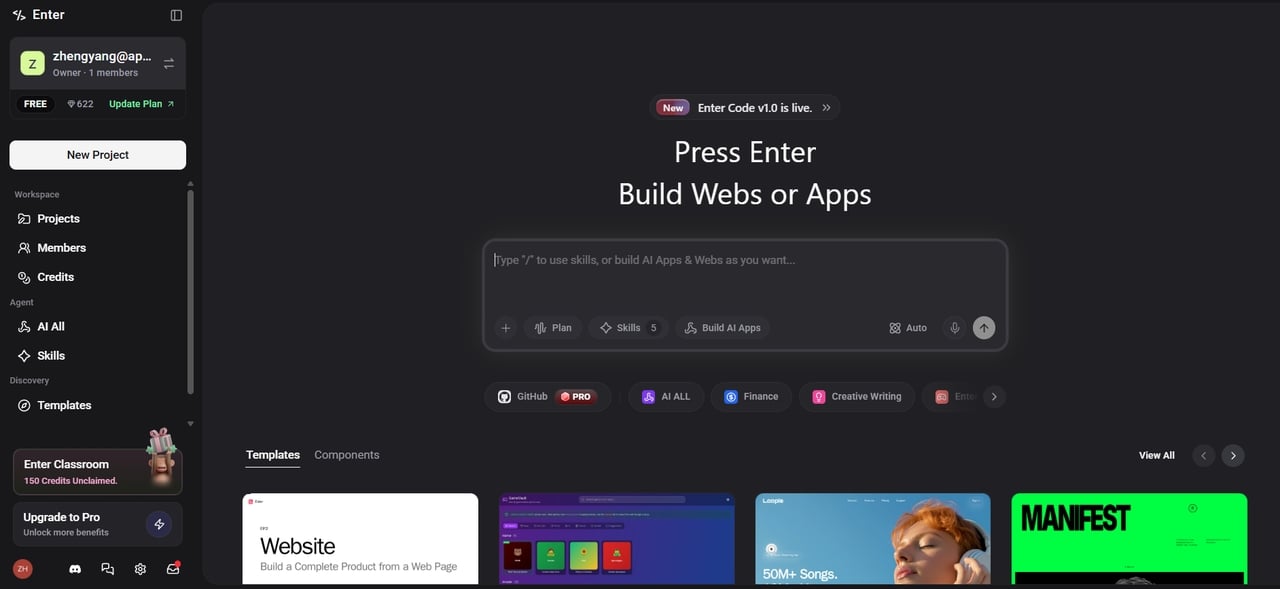
Key features of Enter Pro
-
AI-powered no-code development: Build websites, apps, and digital tools by simply describing your idea in plain language. Enter Pro converts your input into functional products, removing technical barriers and enabling faster execution for entrepreneurs without coding skills.
-
All-in-one development environment: Manage frontend design, backend logic, and workflows within a single platform. This unified environment eliminates the need for multiple tools, reduces complexity, and helps you streamline development from concept to deployment efficiently.
-
**Multi-AI model integration: **Access and leverage top AI models like GPT 5.2, Claude, and Gemini from one interface. This allows you to experiment, optimize outputs, and build smarter applications without switching between platforms or managing separate integrations.
-
Rapid prototyping & deployment: Quickly transform your idea into a working prototype and launch it live with minimal effort. Enter Pro accelerates product development through automation, enabling you to test, iterate, and release faster in competitive markets.
-
**Workflow automation & AI agents: Automate repetitive business tasks and create intelligent AI agents **to handle operations like customer support, data processing, and task management. This improves efficiency, saves time, and allows you to focus on strategic growth.
Conclusion
Finishing your business plan is a significant achievement, but it is only the first step of a much longer journey. The answer to "what must an entrepreneur do after creating a business plan?" lies in the transition from strategist to executor. Success isn't found in the document itself, but in your ability to validate your ideas, secure the right resources, and build a presence that resonates with your target audience.
By focusing on legal setup, team building, and strategic marketing, you turn your roadmap into a functioning reality. Remember that the market is dynamic; use your plan as a guide, but remain agile enough to pivot when necessary. With the right foundation and a commitment to consistent execution, you are well-positioned to transform your entrepreneurial vision into a thriving, scalable business.
FAQs
- What must an entrepreneur do after creating a business plan?
After creating a business plan, focus on validating your idea, securing funding, building a team, handling legal requirements, and launching. Treat the plan as a living document and start executing step by step.
- How soon should I launch after finishing my business plan?
You should validate your assumptions with an MVP or customer feedback first. Most entrepreneurs take 1-3 months to secure funding and set up operations before a full launch.
- Why is validating a business idea important after planning?
Validation ensures there is real demand for your product or service before investing heavily. It helps reduce risk, gather customer feedback, refine your offering, and confirm that your business idea solves a genuine problem in the market.
- How often should I update my business plan?
A business plan is a living document that should be reviewed monthly and updated quarterly. As you gather real-world data and market feedback, you must adjust your strategies and financial projections to reflect the actual performance and changing market conditions.
- What metrics should entrepreneurs track after launching their business?
Focus on Customer Acquisition Cost (CAC), Lifetime Value (LTV), churn rate, conversion rate, and month-over-month revenue growth. These metrics reveal the true health of your business and signal when to stay the course or pivot strategy.